

Germany is moving ahead with a new capacity tendering regime under the StromVKG legislation (BT-Drs. 21/6279, 8 June 2026). BNetzA has been running a series of webinars through June and July 2026 to walk the market through the mechanics, and the first bid deadline is already in September. Below we set out the key dates and design features, and what this means for the German power system as it heads into a tighter decade.
Why this is happening
Germany’s capacity margin has been eroding as older thermal plant retires and coal comes off the system, while renewables are on track to reach an 80% share of generation by 2030. BNetzA’s own Versorgungssicherheitsmonitoring points to a security of supply gap opening up from 2030 onwards. The market has so far been reluctant to commit to new dispatchable capacity given the uncertainty over future revenues, so the government is stepping in with a capacity tender framework to underpin investment ahead of a fuller capacity market from 2032.
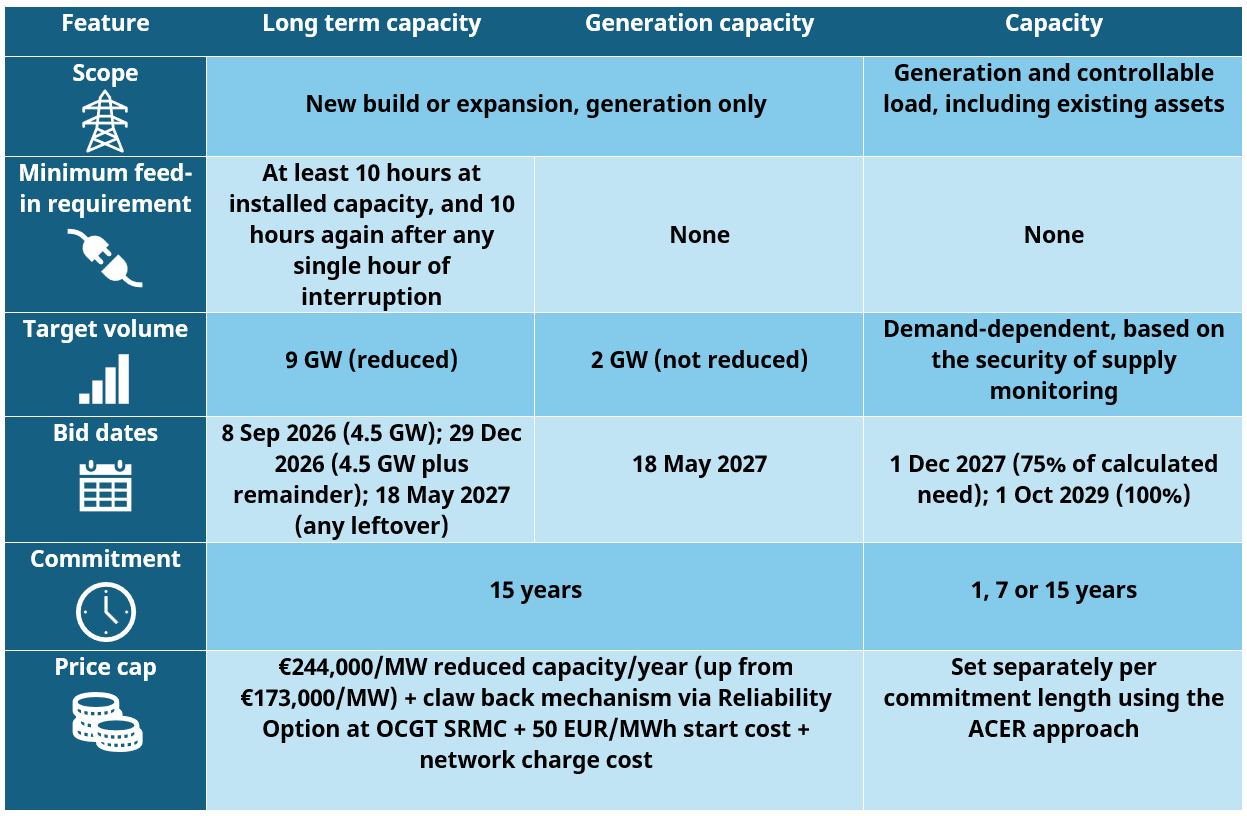
In total, the scheme targets around 11 GW of new dispatchable capacity, split across long-term capacity and generation capacity tenders, followed by a broader capacity segment that also opens up to existing assets and demand-side flexibility.
How the scheme is structured
There are three tender segments, summarised in the table above.
Bids are pay-as-bid, and a Südbonus (south bonus) of €16,000/MW reduced capacity/year is deducted from bids for plant in the netztechnischer Süden, reflecting the value of capacity located closer to demand in southern Germany. Projects will also be required to decarbonise from 2045. Once awarded, capacity holders face ongoing availability monitoring through high price quarter-hour metering and periodic function tests, alongside a price spike clawback mechanism that requires repayment when wholesale prices exceed a daily strike price (set at running cost of an OCGT), regardless of whether the plant actually ran.
Decarbonisation a requirement for bidders
Participation requirements tighten with the length of the commitment, and two of them shape the long-term investment case in particular.
H2 readiness: Gas plant bidding for a 15-year commitment must be hydrogen-ready, meaning it can later be converted to run on 100% hydrogen. Bidders have to submit a conversion concept as part of their bid. This is one of the reasons the cost base for new plant has risen.
Decarbonisation: All assets on a 15-year commitment must give a self-commitment to climate-neutral operation from 2045 onwards. Together with H2 readiness, this ties the tenders directly to Germany’s longer-term decarbonisation path rather than locking in unabated gas.
What it means for the German power system
The scheme is a direct policy response to a system that is becoming structurally tighter. As coal and lignite capacity continues to retire through the late 2020s and renewables penetration rises, Germany faces growing exposure to winter periods with low wind and solar output and limited dispatchable backup. This points toward higher price volatility in winter months over the coming years, particularly in the period before new capacity from these tenders can actually deliver from November 2031. We will consider this in more detail in an upcoming article.
That timing gap is significant. Given the lead time needed to build new gas plant or batteries and the delivery start date of November 2031, there is a real risk of a supply gap in the interim years. This is one of the reasons Germany is now considering delaying the planned retirement of some coal and lignite capacity, to bridge the period until new tendered capacity comes online. The interaction between coal exit policy and this new capacity mechanism will be an important area to watch over the next year or two.
Get in touch
If you’re weighing up whether to bid into these tenders, want a deeper view on how this scheme interacts with German gas plant value and dispatch economics, or are looking at the growing opportunity for battery storage in a system heading toward greater volatility, we’d be glad to talk it through. Reach out to the Timera Energy team.