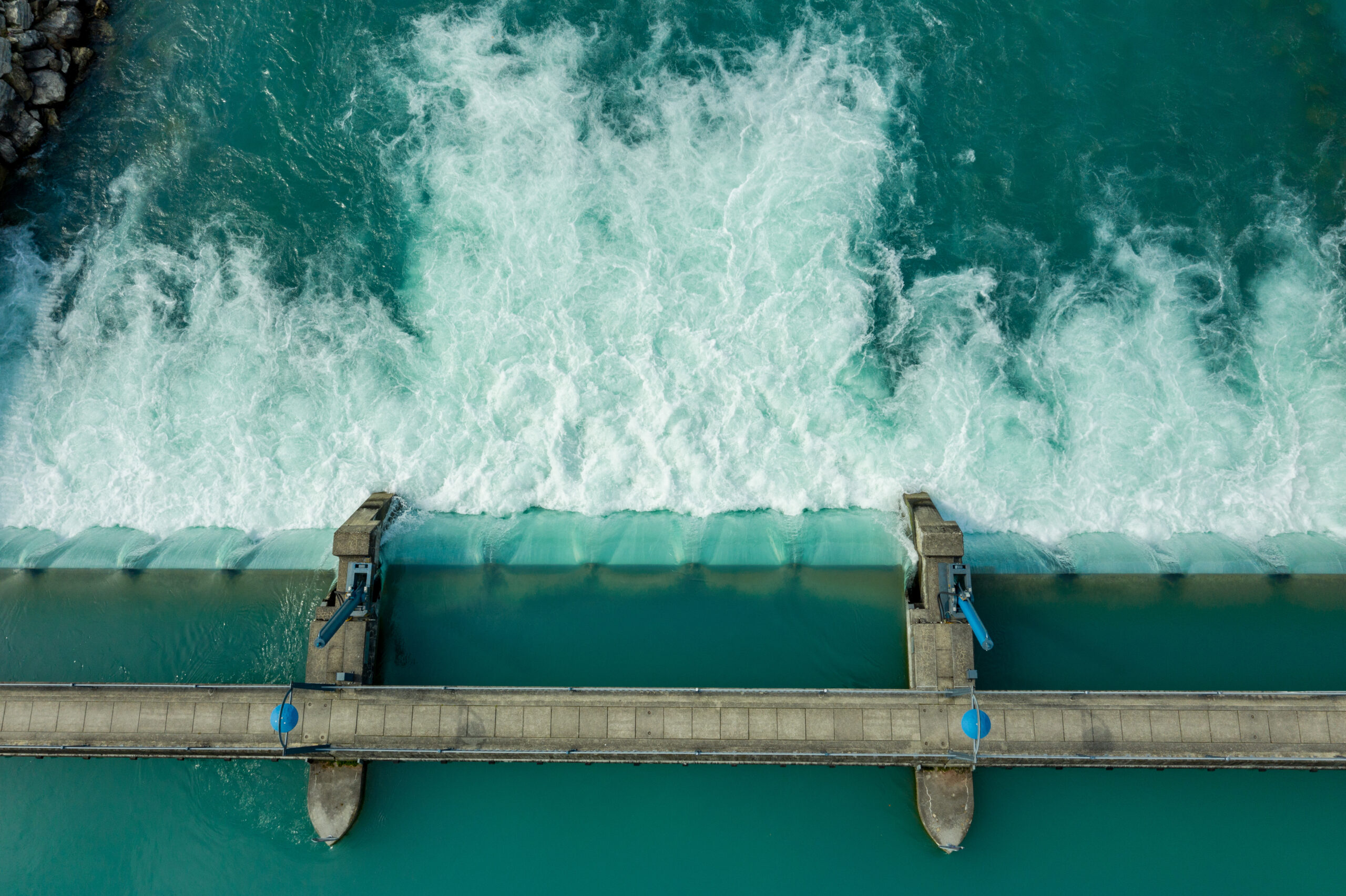


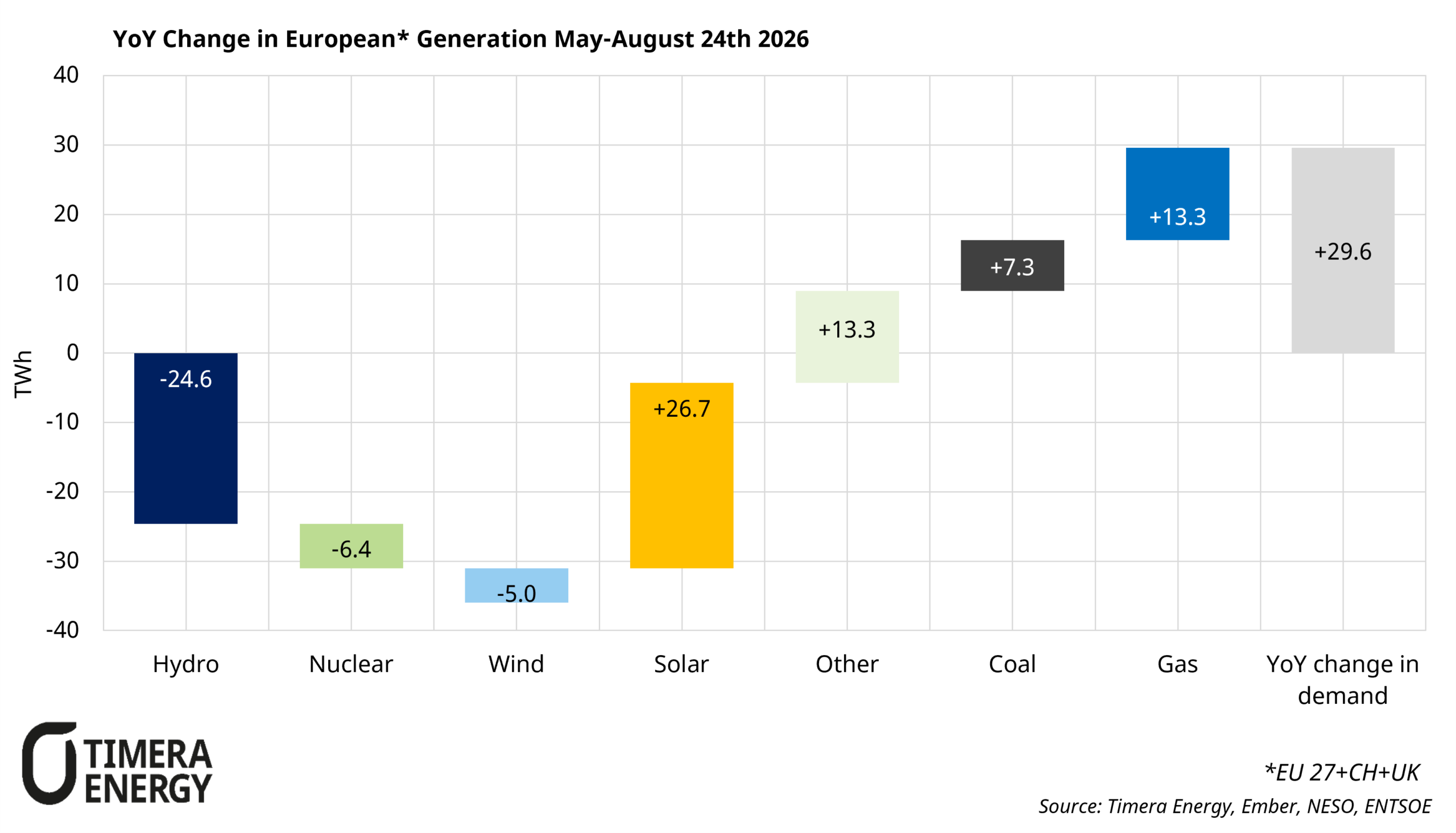
Drought conditions across Europe have strained the continent’s power grid this summer. In Switzerland, a dry winter followed by summer drought has left reservoirs low and hydro output down, while the Po, Rhone and Rhine have all fallen to record lows.
Low river levels and high temperatures have also hit nuclear availability. A June heatwave pushed Seine and Rhone temperatures towards EDF’s regulatory cooling limits, forcing the shutdown of both Nogent units and all four at Bugey in a single day, cutting around 4.1 GW. In Hungary, record low Danube levels took two of four units offline at Paks, which supplies nearly half the country’s power, its first full shutdown in 44 years, with output down to around 25% of capacity by early August.
Wind generation also fell sharply in June, with low wind speeds across much of Europe. This amplified the drought impact, leaving two key supply sources constrained at the same time through the summer.
Gas’s response is a useful reminder of the role it still plays in balancing an increasingly weather sensitive system. But with TTF prices sitting well above their 2025 levels as disruption to shipping through the Straits of Hormuz continues to roil the global LNG market, that additional gas burn fed straight through into higher power prices.
Coal prices have been relatively unaffected by the crisis, but declining coal capacity in Europe limits the ability to switch away from gas as gas prices rise. Around 80% of the gas generation increase is localised to GB, Italy and France, markets with limited or no coal capacity. In markets like Germany, where coal remains a significant part of the mix, more coal was burned than gas in response to the strain on the system, with German coal generation rising more than twice as much as gas generation over the period.
Europe’s gas generation will only become less responsive to wholesale gas prices as coal plants retire. By 2030, Timera expects the share of gas generation that is switchable against coal in the €15-30 gas price range to fall from around 8% of total gas generation in 2026 to just 4%.
As renewables build out and system swings become more weather driven, that flexibility becomes more valuable, which is a key reason we are seeing renewed investor interest in gas flex assets such as peakers.
If you are investing in flexible assets in Europe reach out to the Timera team to discuss our views on the market and see how we can support.