

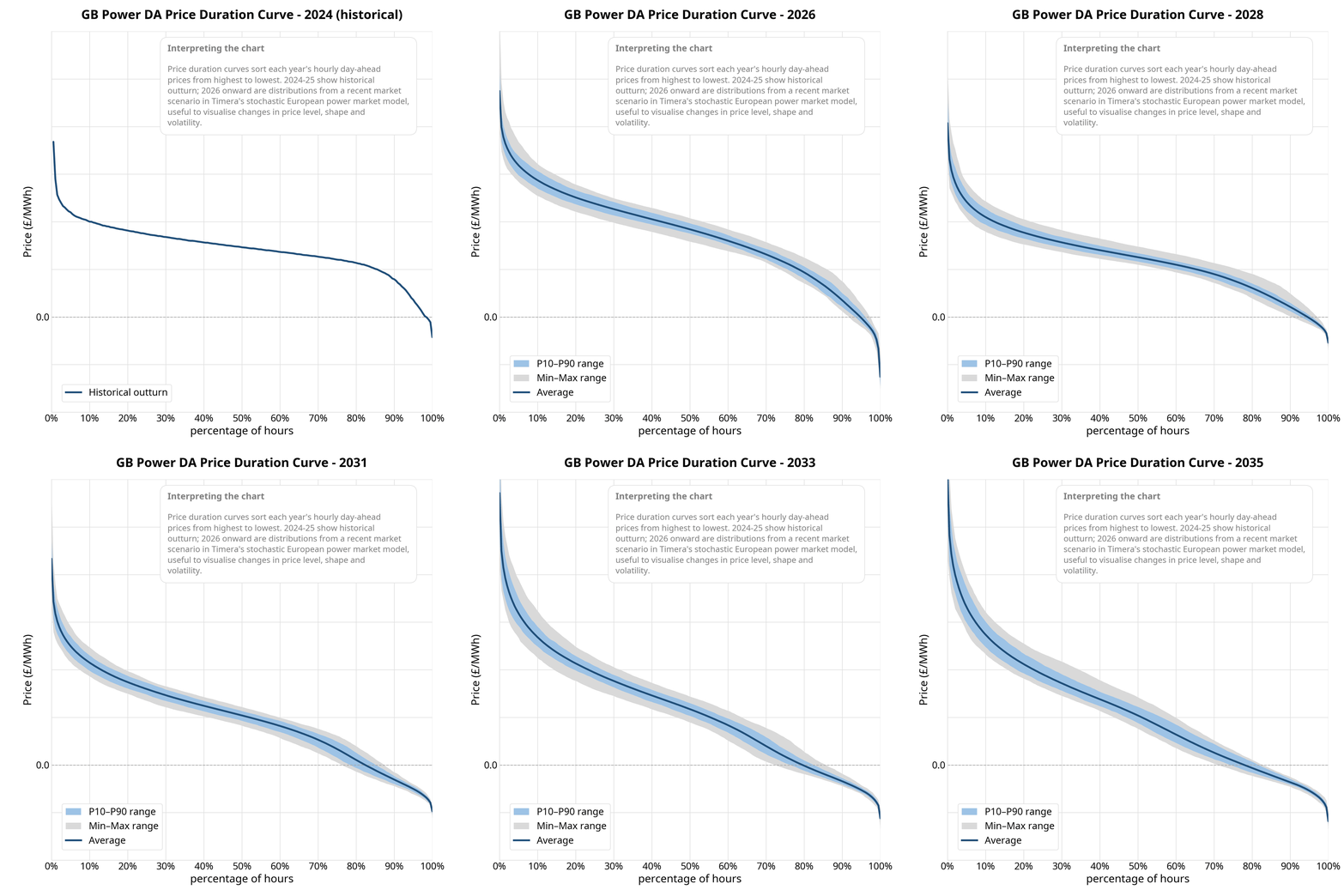
Price duration curves (PDCs) are one of the most compact ways to read a power market. Sort every hour of the year from the highest price to the lowest, and the resulting curve captures three things at once: the absolute level of prices (how high the curve sits), the shape & steepness (the spread between evening peaks and the cheapest, increasingly negative hours), and the volatility (how far prices swing around the central case).
The animation above shows GB day-ahead PDCs evolving from 2024 historical outturn through a recent scenario run in our stochastic European power market model. Three themes stand out.
- Falling and flattening in the near term. As gas prices ease over the next couple of years, the whole curve drifts lower and flattens. Lower marginal fuel costs pull the price level down, and the peak-to-baseload spread compresses, taking some of the steepness out of the curve.
- A steepening from 2031. Further out, the low-price end drops away more sharply, more hours at low and increasingly negative prices, and the curve begins to steepen again. This is the fingerprint of a system with more renewables and less mid stack baseload generation meaning abundant near-zero-cost supply in surplus hours, firmer prices when it is scarce.
- Widening bands = rising volatility. The shaded ranges widen across the horizon. Greater dispersion between simulations reflects rising price volatility as the generation mix tilts further towards weather-driven supply.
Why this matters for BESS
Battery merchant value is a play on price shape and volatility, not level. The near-term flattening is a headwind, thinner spreads compress wholesale arbitrage margins as gas falls. But the picture that builds from the turn of the decade is constructive. A steeper curve – more negative-priced hours to charge into and firmer peaks to discharge against – widens the spreads batteries monetise, while rising volatility lifts the value of their optionality and their ability to capture short, sharp price events.
Read this way, the evolution of the PDC is effectively a map of how merchant BESS spreads are likely to compress and then recover across the decade, and why value increasingly accrues to assets that can respond to volatility rather than simply arbitrage a stable daily shape.
GB BESS Service — Q2 update out this week
Our latest quarterly GB BESS update lands this week, with refreshed merchant value projections, revenue-stack analysis and the scenario drivers behind them. Contact Arshpreet Dhatt, Principal, arshpreet.dhatt@timera-energy.com to access the full release.