


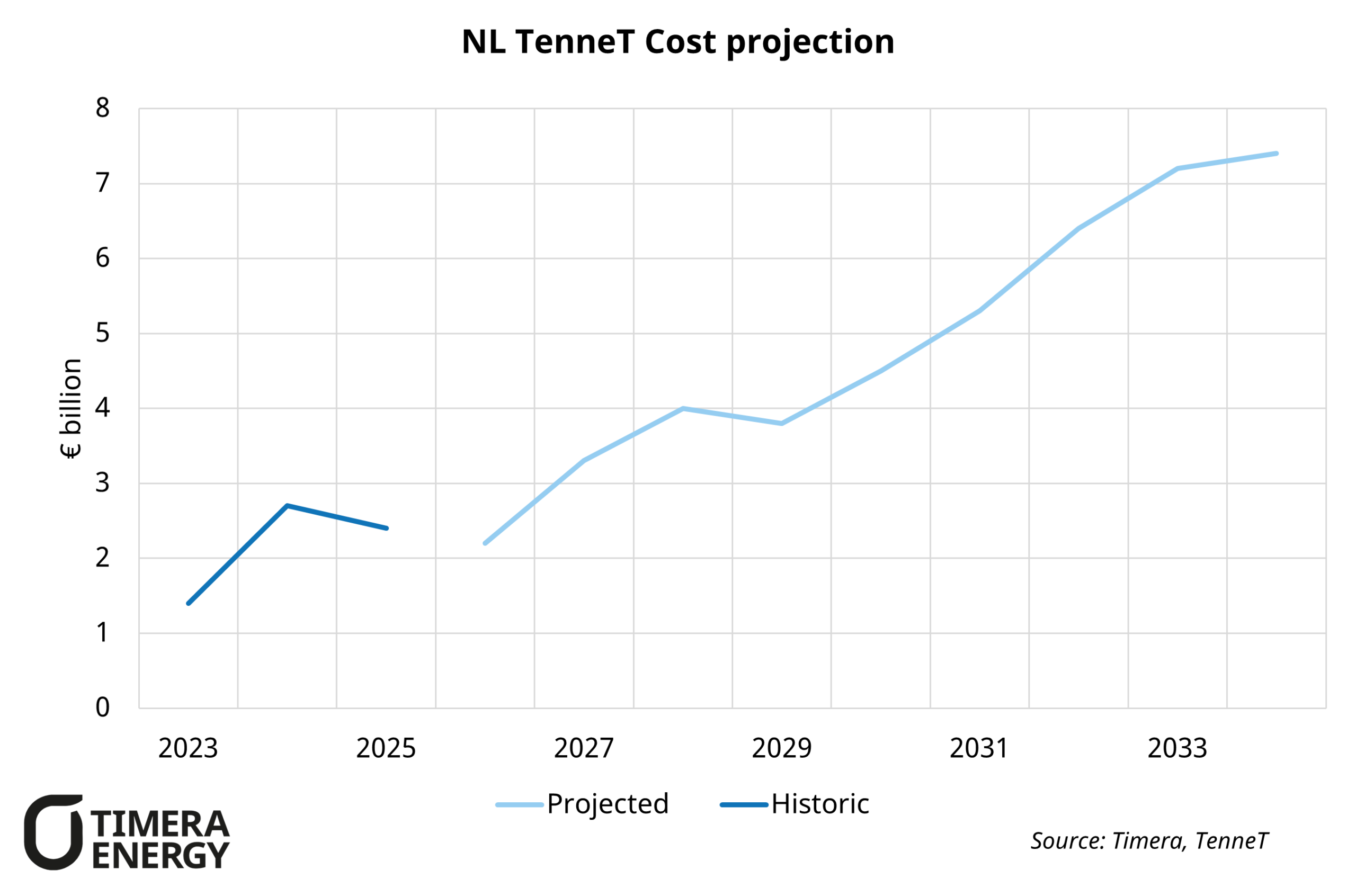
Chart: Forecast from June 2025 showing the projected permitted revenues for TenneT. This is the key driver behind transport tariff levels in NL for TenneT EHS and HS grid connection levels.
The Dutch regulator ACM announced last week that it is moving forward with the proposal to introduce a feed-in tariff that will require large electricity producers to contribute towards rising grid expansion and reinforcement costs. The scheme is not expected to take effect until at least January 2032 and is set to apply broadly across renewables, nuclear and fossil generation.
The rationale is a familiar one across European power markets. Grid build-out costs are escalating faster than incumbent tariff structures can absorb, driven by the offshore wind connection programme, onshore reinforcement to relieve congestion, and accelerating electrification of demand. Total Dutch grid costs are forecast to rise underpinned by over €200 billion of system operator investment. ACM’s view is that producers and foreign offtakers should share that bill rather than leaving it entirely with Dutch consumers and industrial users.
Two key uncertainties remain. First, whether existing assets will be grandfathered or whether the tariff will apply retroactively. The industry argues retroactive application would render some projects financially unviable, and the concern is particularly acute for offshore wind where business cases are already under pressure from rising capex, supply chain costs and weak auction outcomes. Second, the level of the tariff itself, which ACM has yet to quantify. Until both are resolved, investment cases across the Dutch generation stack carry a material policy overhang.
For BESS the picture is more nuanced. Standalone batteries are currently classified as consumers rather than producers, so they sit outside the feed-in tariff debate on the supply side. However any change in how grid costs are allocated across market participants could have a knock-on impact on the demand-side grid costs that batteries already pay. BESS economics in the Netherlands currently benefit from TenneT’s ATR85 non-firm contract structure combined with time-of-use tariffs, which together deliver up to a 65% discount on grid fees for flexible operation. The feed in tariff reform is therefore less directly impactful but certainly one to watch.
Timera has supported investment in flexible generation such as gas peakers, BESS, CCGTs and more across the Netherlands and wider Europe. With our proprietary modelling suite we can forecast revenues under various grid fee regimes, connection agreements and other bespoke arrangements. If you want to learn more about how we can support please reach out to Arshpreet Dhatt, Principal (arshpreet.dhatt@timera-energy.com)