Grid fees can make or break a BESS investment case
European network operators are entering one of their heaviest investment cycles in decades, and grid fees are rising to fund it. For example in GB, total transmission network usage (TNUoS) revenue to be recovered is forecast to rise from £8.9bn in 2026/27 to £13.6bn by 2030/31.
Battery storage sits awkwardly within this framework: it consumes power when charging and generates when discharging. Several markets therefore exempted storage from grid fees, partly on the basis that batteries can help relieve congestion.
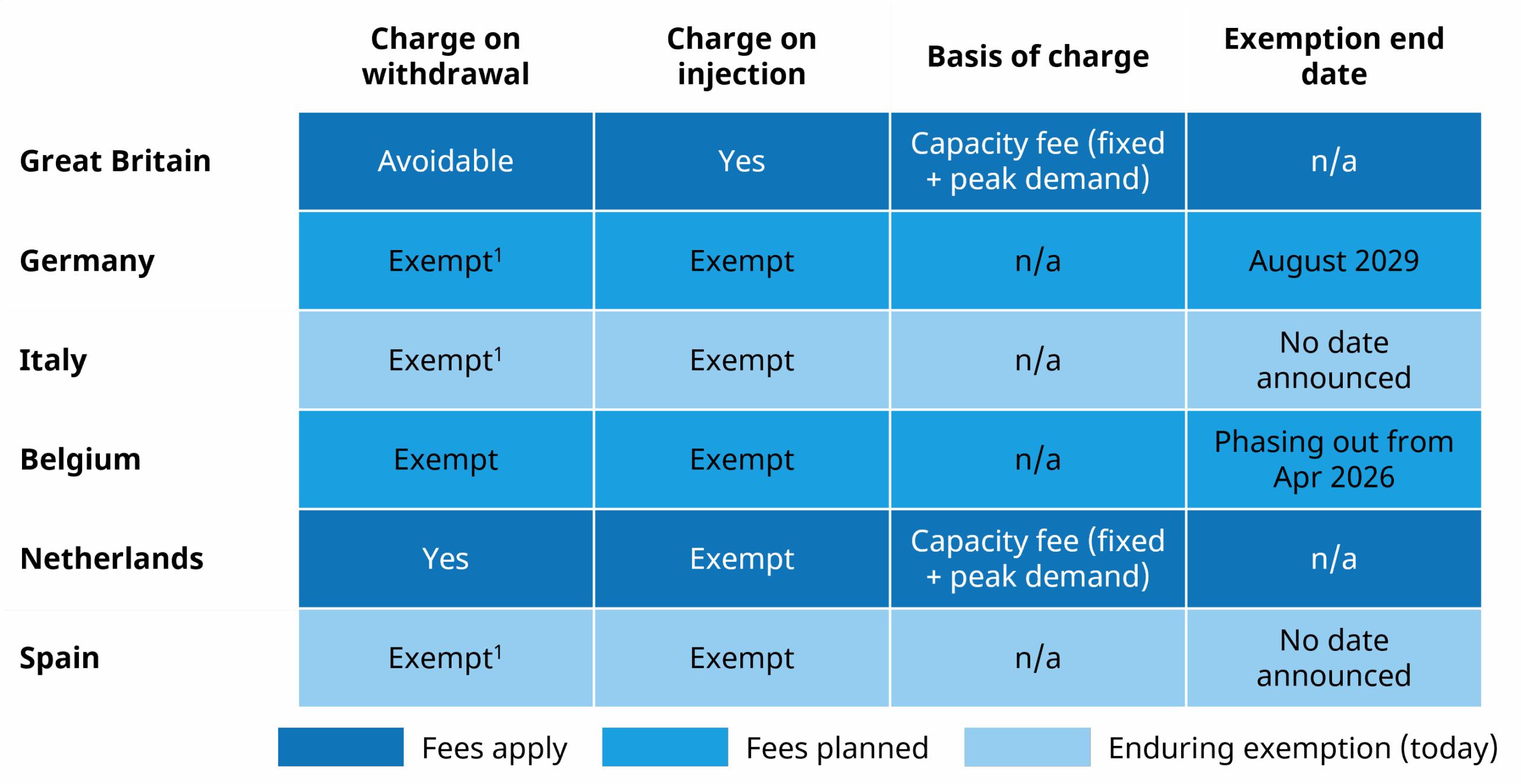
That position is changing. Germany’s exemption will expire, Belgium is phasing its out, while the Netherlands has always charged batteries.
Investors have often treated grid fee exposure as a binary risk: exempt or not. But the impact on returns can depend far more on how the charge is designed, particularly whether it is based on capacity or energy, and whether it varies by location or time.
The article explores how grid fee regimes are changing across six European markets and what those changes mean for BESS project economics, risk and investment decisions.
Grid fee regimes are changing across Europe
Let’s compare six key European markets spanning exempt, transitional and fully charged regimes as of August 2026. In several, exemptions now depend on meeting a connection or investment deadline. Table 1 summarises the current position.
The direction is broadly consistent: regulators increasingly want storage to contribute to grid costs while still rewarding behaviour that supports the network. Three themes recur: fewer blanket exemptions, greater use of capacity-based charging, and discounts or credits linked to where and when batteries operate.
In Chart 1 we show a comparison of BESS grid fee ranges across key European power markets, to give a sense of the broad dispersion of current approaches.
Chart 1: Approximate 2026 grid fee exposure for 2 hour duration BESS asset
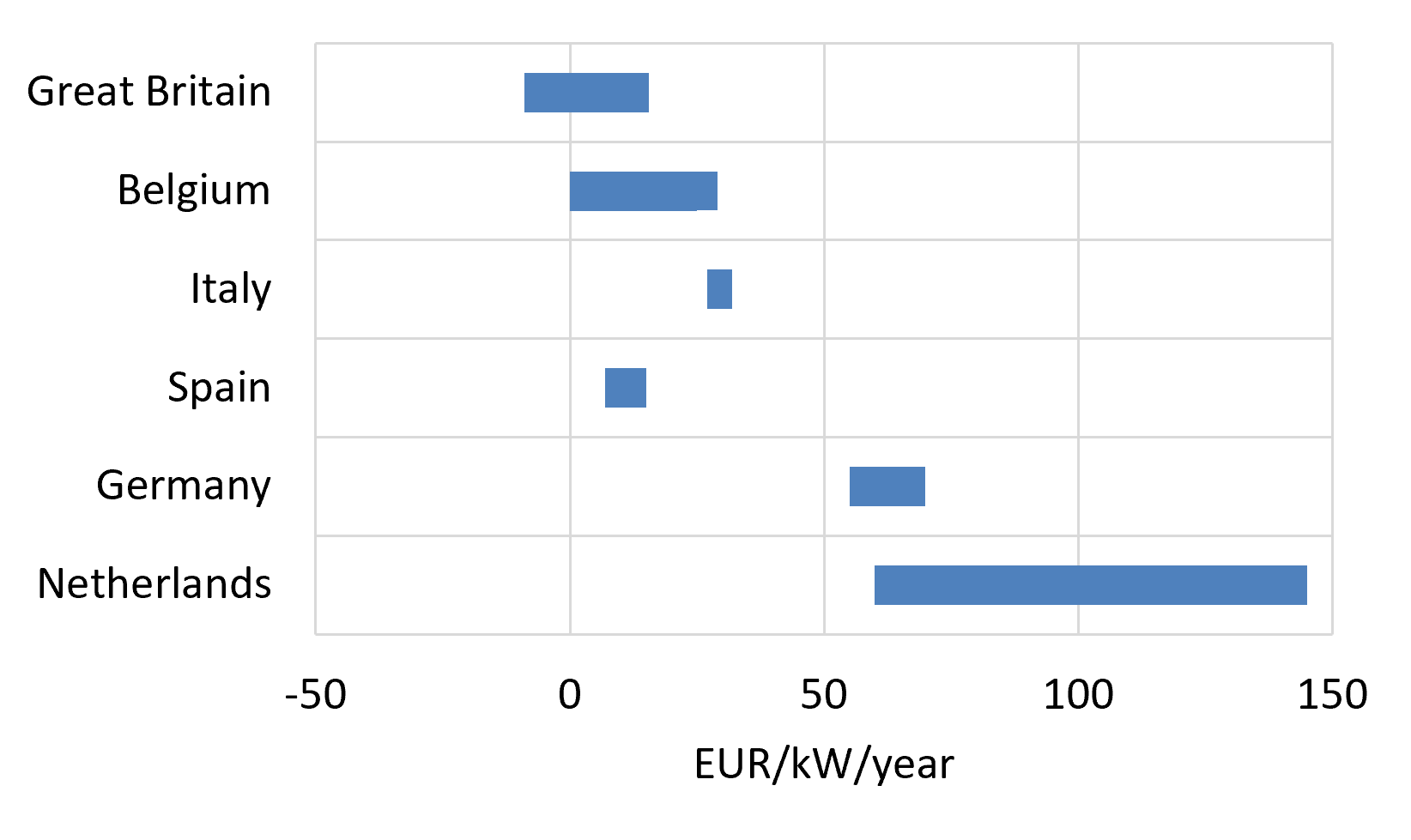
Source: Timera; note - based on no discounts or exemptions for a 2hr BESS at 1.5 cycles per day.
Let’s now do a quick ‘grid fee’ tour of key European BESS markets to understand key differences in approach and path forward.
GB: no exemption, but charges can be managed
GB shows that BESS can scale without a blanket exemption, but site choice and TNUoS reform remain important to project economics.
- Transmission-connected batteries pay generation TNUoS; there is no blanket storage exemption.
- Charges are zonal and locational, so batteries in some demand-constrained zones can receive a benefit rather than incur a cost.
- GB has still built the deepest battery fleet in Europe, showing that an exemption is not a precondition for deployment.
- TNUoScosts are rising into RIIO-ET3 and reform remains uncertain, so investors need to test both current and future charging.
Germany: near-term certainty improved, but timing matters
Germany now offers greater near-term certainty, but project timing and the charging regime after the exemption remain central to returns.
- The current exemption is expected to run to August 2029 for projects that lock in a firm commitment in time.
- Uncertainty over an earlier withdrawal had delayed investment decisions; confirmation of the deadline has restored greater certainty.
- Germany plans to charge storage on capacity rather than energy. That should have a much smaller impact on returns than an energy-based charge.
- From 2030 at the earliest, dynamic fees are planned forinitialasset classes, varying by time and location and potentially rewarding grid-supportive dispatch.
Belgium: timing now drives fee exposure
Belgium is creating a clear split between earlier projects that retain fee protection and later projects that need to price in network charges.
- Transmission-connected batteries were granted a ten-year exemption from Elia network charges from commissioning.
- That exemption is being phased out for projects signing grid connection agreements after 1 April 2026.
- Projects signing connection agreements now, or commissioning from 2028 onwards, should expect additional network charges.
- Flexible connection agreements can reduce those charges in exchange for some operational flexibility.
Netherlands: high fees, but flexibility can cut the cost
The Netherlands shows how significant grid fees can be managed through operating flexibility rather than exemptions.
- Batteries have always paid under the technology-neutral regime.
- Transmission grid fees have exceeded €100/kW/year in recent years, materially challenging otherwise attractive BESS economics.
- Non-firm or time-bound transport contracts can trade roughly 15% curtailment risk for around 60% lower grid fee exposure.
- For investors, the key trade-off is the value lost through curtailment versus the grid fee saving.
Italy: exempt today, but not guaranteed
Italian generators, including BESS, remain effectively exempt today, but the relief is administrative rather than statutory.
- Under ARERADelibera574/2014, electricity withdrawn purely to charge storage for later injection can be treated as exempt from charges.
- The relief requires an application supported by certified technical evidence. Because the relief is administrative rather than statutory, it can be revisited without primary legislation.
- Nonetheless the current Italian model is focussed on grid fees for consumers, with exclusions for BESS, and no plans to change this currently.
- MACSE’s first auction awarded around 10 GWh of 15-year storage contracts, adding revenue certainty that can help absorb future grid fee changes.
Spain: low exposure today
Spain also has little grid fee exposure for front-of-meter storage today, although the current treatment is not guaranteed over an asset’s life.
- Tolls and charges apply to consumption rather than the provision of flexibility, leaving standalone and hybrid front-of-meter storage effectively unexposed.
- Developers are using colocation with solar and hybrid PPAs with utilities and industrial players.
- Contracted revenues can provide more protection if grid fee treatment tightens.
5 key takeaways for BESS investors
Let’s finish with some practical considerations as to how grid fees should be factored into BESS investment case analysis:
1. Model the charging basis, not just the headline fee. Capacity- and energy-based charges can have very different effects on cycling economics and returns. A single grid-cost stress can miss this.
2. Price project timing into asset value. In Germany and Belgium, connection or investment dates can determine exemption status and therefore lifetime grid costs.
3. Compare fee savings with lost operating value. Location, dispatch and flexible connections can cut grid costs but may constrain operation. This has a very real and dynamic impact on value – with stochastic modelling required to quantify impact on asset margin distribution.
4. Stress value impact of fee structure changes. For example Italy and Spain have low exposure today, but investors should not assume that lasts for the full asset life.
5. Compare markets on net returns, not headline spreads. Attractive power and ancillary service revenues can be offset by grid costs. Grid fees should therefore be built into market and site screening from the outset.
Timera is hiring
We are growing our team and looking for experienced candidates with a passion for energy. Building on 15 years advising leading energy investors and companies, we are currently hiring for:
- Principal / Senior Analyst – Power
Interested in more details? Please contact us via recruitment@timera-energy.com.
Timera has established recruitment partners in place and kindly asks other agencies not to contact us.