“Location sets opportunity… optimiser strategy drives value capture”
The GB battery investment case is evolving. As ancillary markets have saturated and the fleet has expanded, value has shifted towards wholesale trading and the Balancing Mechanism (BM). Location and optimiser capability are therefore becoming increasingly important drivers of realised revenue and asset value.
Two batteries with similar technical characteristics can now have very different revenue stack and risk profiles. Even where headline margins look comparable, the underlying sources of value and their exposure to market or regulatory change may be materially different.
In today’s article we look at the evolving drivers of GB BESS revenue, showing revenue stack capture across a range of assets.
GB asset revenue capture
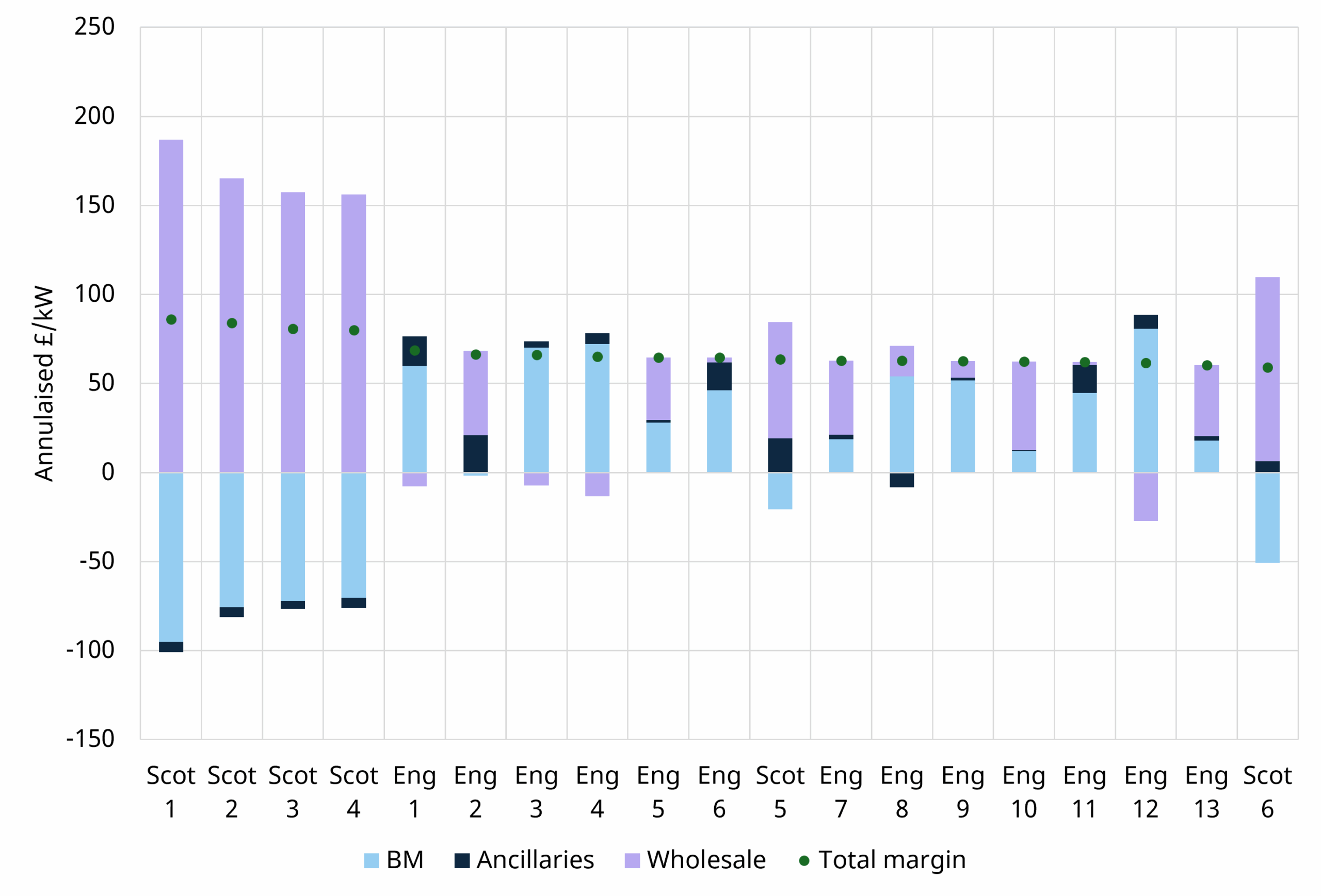
Chart 1 compares the annualised January-July 2026 margins of 20 leading GB BESS assets. Total margins are relatively clustered, but the contributions from wholesale, BM and ancillary services vary markedly.
The chart highlights why investors need to look beyond headline performance and understand how asset margin is generated.
Location shapes the opportunity
The first four assets in Chart 1are located in Scotland behind material transmission constraints. They show strongly positive wholesale margins combined with negative BM margins. This reflects a repetitive re-trading strategy: assets build wholesale positions and are subsequently paid through BM bids to reduce output. The accounting split looks unusual, but the combined strategy has generated some of the highest margins in the index, particularly above the B4 boundary.
English BESS assets show a more varied mix. Some rely heavily on BM offers when NESO takes actions in the south, while others trade wholesale spreads with a more balanced mix of bids and offers and use ancillary services to supplement revenue. Location therefore shapes the opportunity set available to an optimiser; it is not simply a background asset characteristic.
However, locational advantage is not necessarily permanent. NESO’s proposed reform of repetitive re-trading could materially alter the economics of strategies used in constrained areas. Historic margins need to be therefore separated into structural locational value and value that depends on current market rules.
Optimiser strategy drives value capture
Location alone does not explain the divergence. As ancillary revenues have declined, optimisers have needed to rotate capacity more actively between wholesale and BM opportunities. Strong execution requires round-the-clock coverage, rapid response to volatile periods and the discipline to increase cycling when spreads justify it while protecting degradation value when they do not.
BM performance also depends on understanding the competing bid stack. An optimiser that anticipates the dynamic parameters and bidding behaviour of other technologies (particularly CCGTs) can position a battery to reduce skip rates. Weak execution can leave an otherwise attractive asset repeatedly out of merit and unable to capture the opportunity visible in market prices.
What this means for investors
Similar total realised margins do not imply equivalent value or risk. Investors need to distinguish between value created by location, value dependent on market design and value attributable to repeatable optimiser capability. This distinction also matters when selecting route-to-market structures: a floor or profit-share arrangement is only as attractive as the optimiser’s ability to capture the revenues on which it is based.
How can we help?
Timera’s stochastic BESS modelling quantifies the distribution of potential revenues across wholesale, BM and ancillary markets, rather than relying on a single deterministic case. Detailed zonal constraint modelling then captures how network congestion affects local dispatch, BM actions and asset-specific opportunity.
Together, these tools help investors quantify upside, downside and the durability of different revenue sources when valuing assets and assessing route-to-market risk. If you would like to find out more, reach out to our Steven Coppack (Director, Power) at steven.coppack@timera-energy.com.
Timera is hiring
We are growing our team and looking for experienced candidates with a passion for energy. Building on 15 years advising leading energy investors and companies, we are currently hiring for:
- Principal / Senior Analyst – Power
Interested in more details? Please contact us via recruitment@timera-energy.com.
Timera has established recruitment partners in place and kindly asks other agencies not to contact us.