“Winter price spike masks a deeper storage challenge”
Timera spent three days at Gastech in Bangkok meeting portfolio players, producers, utilities and traders across the LNG value chain. Near-term attention focused on European storage and LNG flows through the Strait of Hormuz, while companies also considered how to position portfolios for a wave of new supply later this decade.
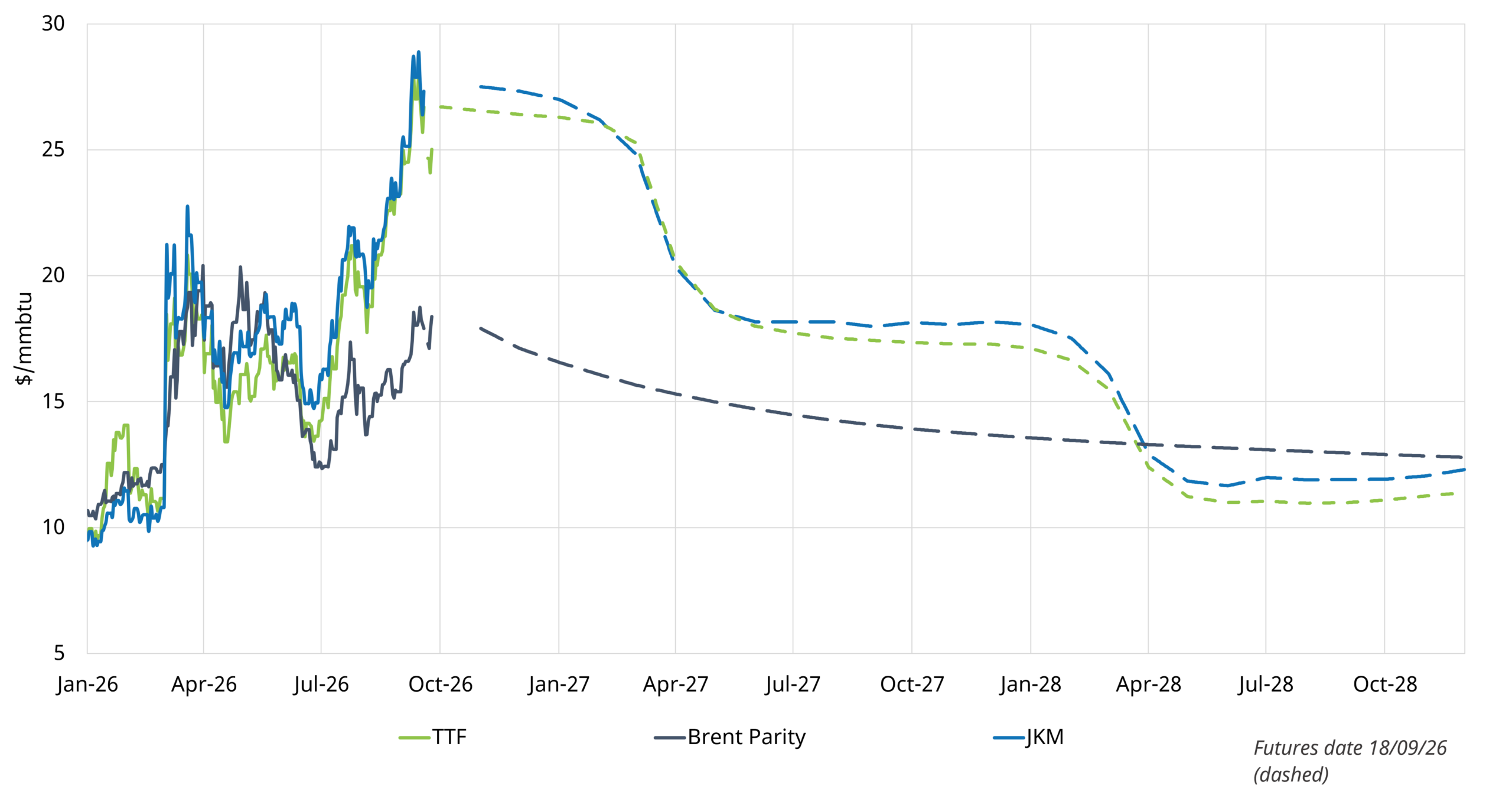
Discussions took place against a backdrop of winter JKM and TTF prices surging above $25/mmbtu, with forward curves in strong backwardation (Chart 1). This brought immediate winter risks into focus alongside the longer-term impact of the looming supply wave.
Five themes stood out.
1. All eyes are on winter, but Europe’s storage problem runs deeper
LNG flows through the Strait of Hormuz and European storage withdrawals dominated near-term discussions, particularly how low EU stocks could fall by the end of winter.
A more persistent problem is the multi-year backwardation in the TTF curve, which is compressing the summer-winter spreads that underpin storage economics. Storage operators are struggling to secure bookings, increasing the risk of asset closures.
If that erosion continues, more European markets could move towards a UK-style model, relying on LNG flexibility to balance the system. We explored the implications in our earlier article on UK storage and LDCs.
2. Appetite for portfolio supply remains, with Asia the focus
Many companies still have mandates to build LNG supply positions, suggesting the current wave of final investment decisions has further to run. Fewer buyers and portfolio players are positioning to sell into Europe, despite Russian pipeline gas remaining out of the system. Declining demand, decarbonisation policy and methane regulation are concerns; Asia is the focus.
This is boosting interest in supply outside the US Gulf Coast, particularly Western Canada and Asia-Pacific projects with shorter shipping routes to Asian markets.
3. Buyers are moving away from Henry Hub
Henry Hub indexation is losing appeal among buyers. Many Asian buyers built up Henry Hub exposure in recent years and are conscious of the coming supply wave. Interest is shifting towards Brent-linked and JKM pricing.
Some European DES buyers are also favouring TTF over Henry Hub. Geopolitical risk plays a part, with buyers wary of concentrating exposure on US sellers.
4. Contract structures are getting more creative, and pricing them matters
Buyers and sellers are trading off price, indexation, volume flexibility and destination optionality to get deals done. Hybrid indexation and bespoke flexibility carry value that needs to be priced accurately.
Price simulations grounded in supply and demand across hubs capture the regime shifts that drive much of this value. Used alongside Monte Carlo calibrated to historical volatility and correlations, they give a more complete basis for valuing contract flexibility. Timera is supporting clients with this analysis.
5. EU Methane Regulation is now a live issue in European deals
The EU Methane Regulation has become a key negotiating issue. A likely delay to penalties has done little to ease concerns: for many counterparties, the greater risk is reputational damage from appearing on a non-compliance list.
Uncertainty is slowing European contract negotiations as parties work out how to allocate obligations whose practical requirements are still taking shape. US sellers hope country-level equivalence will simplify compliance, but methane terms will remain difficult until the framework is clearer.
For further details reach out to Luke Cottell (Associate Director) luke.cottell@timera-energy.com.
Have a look at practical case studies of our client work
We have recently launched an updated set of pages on our website with details of Timera services including practical client case studies of work we are doing: