“Low stocks amplify late winter gas price risk”
In last year’s winter outlook, we highlighted Europe’s exposure to a cold winter following Russian supply cuts in 2021–22. We expected the approaching wave of new LNG supply to begin easing this asymmetric upside risk in 2026. Forward markets were pricing a similar outlook.
Eight months of disruption to LNG exports through the Strait of Hormuz have changed that equation. New supply outside the Middle East is helping, but Europe enters winter with lower stocks and Asia has already used much of its demand-side flexibility.
Our winter 2026/27 outlook assumes Hormuz remains closed through Q4 2026, with gradual reopening through Q1 2027. Under this scenario, late-winter price upside becomes particularly acute if European stocks run low.
Europe enters winter with a smaller buffer
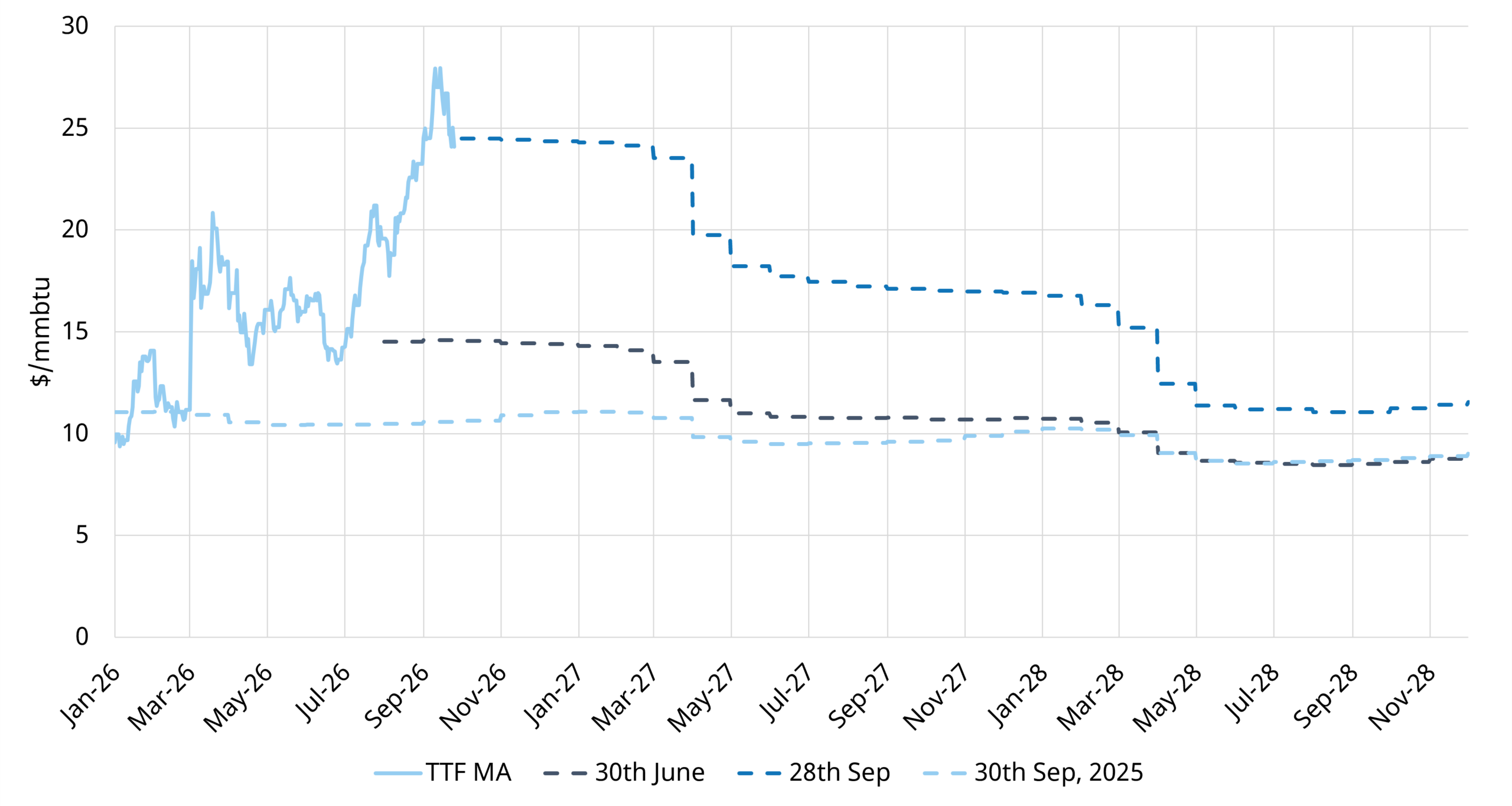
Winter gas prices have repriced sharply higher as expectations of an early reopening have faded. Chart 1 shows the shift in the TTF forward curve since June, alongside the much lower prices anticipated a year ago.
Chart 1: TTF forward curve evolution
Source: ICE, Timera Energy
Europe has nearly 13 bcm less gas in storage than at the same point last year. Reduced summer injections have absorbed part of the loss of Middle Eastern LNG supply, helping balance the global market but leaving less gas available for winter.
That matters because storage provides a buffer against higher heating demand. With a smaller buffer, Europe is more exposed to additional LNG requirements during cold periods, when Asia may also be competing for cargoes.
New LNG supply cannot fully offset the disruption
The new LNG supply wave is still ramping up outside the Middle East. However, under our Hormuz assumption, these additions are insufficient to replace disrupted exports.
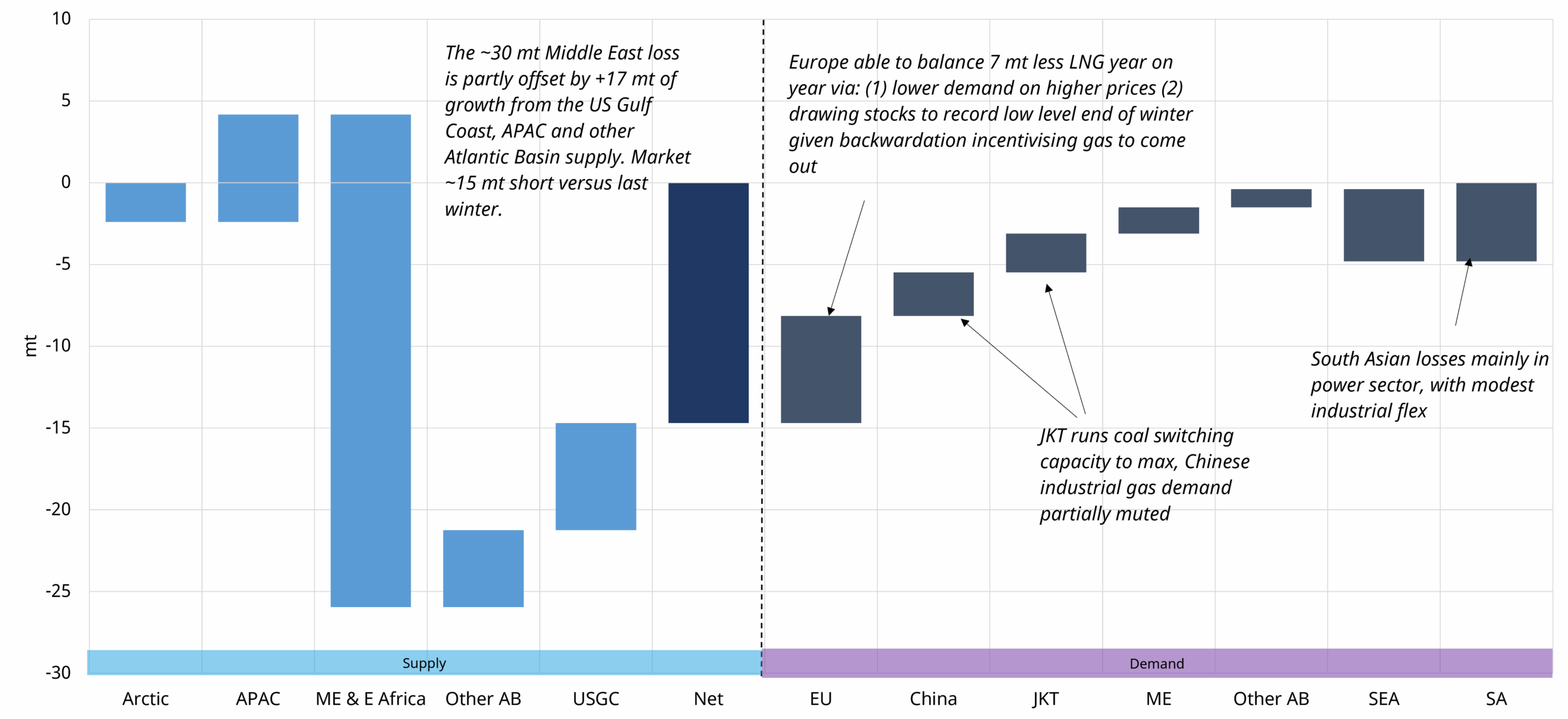
Chart 2 shows a net decline of approximately 15 mt in global LNG supply versus last winter. The demand side of the waterfall illustrates how this tighter balance is absorbed across importing regions.
Chart 2: Winter 2026/2027 global LNG supply and demand waterfall - year-on-year
Source: Timera Global Gas Model, LNG Unlimited
Europe balances lower LNG availability through a combination of reduced demand and storage withdrawals. Asia relies more heavily on fuel switching and reductions in price-sensitive consumption. The challenge is how much further these responses can stretch if winter demand exceeds expectations.
Asia has limited remaining demand flexibility
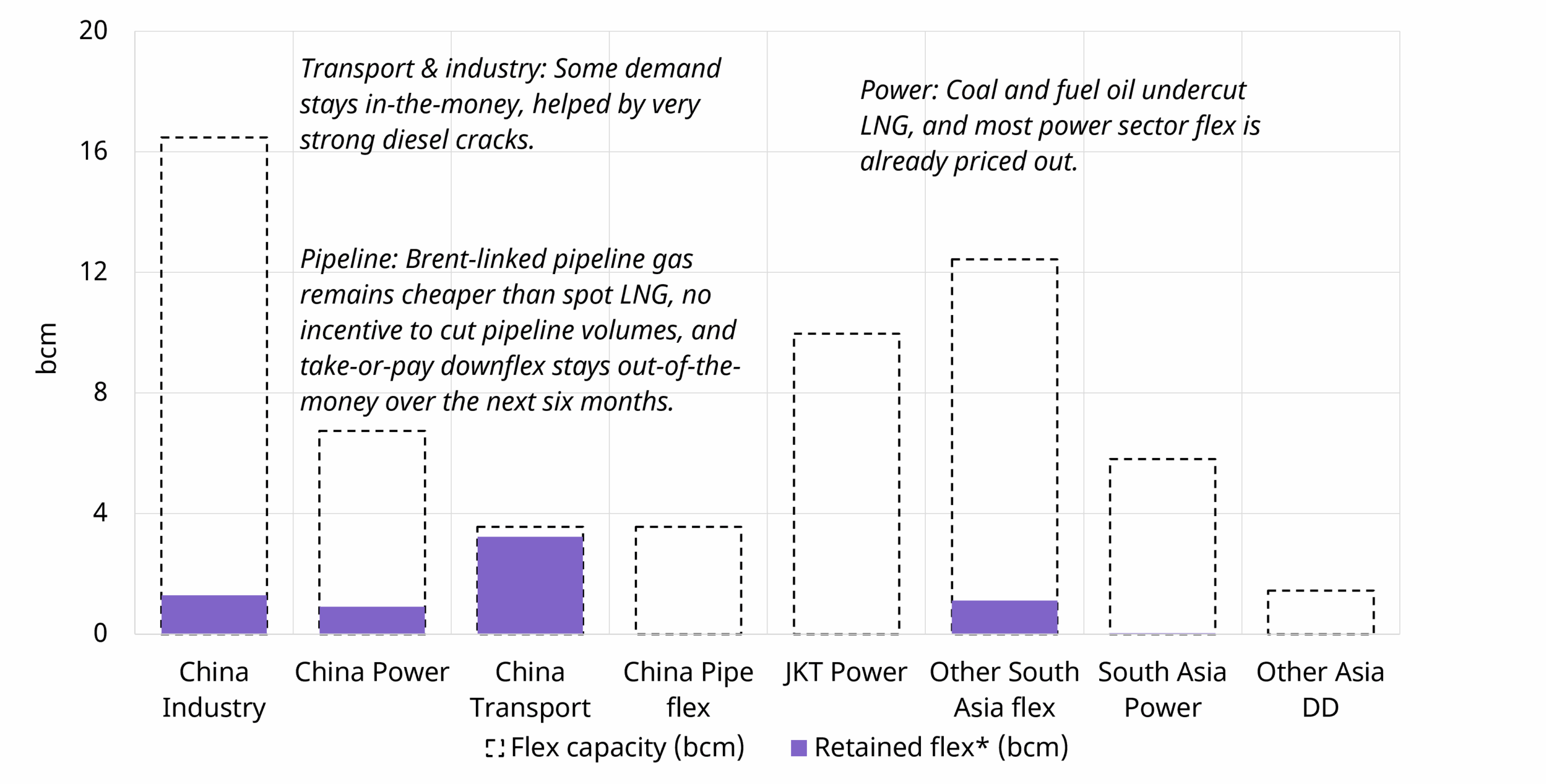
Asian demand has already responded to prices above gas-to-coal and gas-to-oil switching levels. Chart 3 shows the remaining demand that could still be displaced at higher prices.
Chart 3: Winter 2026/2027 Asian demand-side switching by sector
Source: Timera Global Gas Model. Retained flex: in-the-money demand that could still be priced out at higher prices.
Most identified power-sector flexibility is already priced out, with coal and fuel oil undercutting LNG. Some transport and industrial demand remains competitive, supported by high diesel and refined-product prices.
Our analysis indicates that around 87% of identified price-sensitive Asian demand is already priced out. Above approximately $20–25/mmbtu JKM, further demand reductions require progressively higher prices. This limits Asia’s remaining ability to cushion an additional supply or weather shock.
Low stocks amplify late-winter price upside
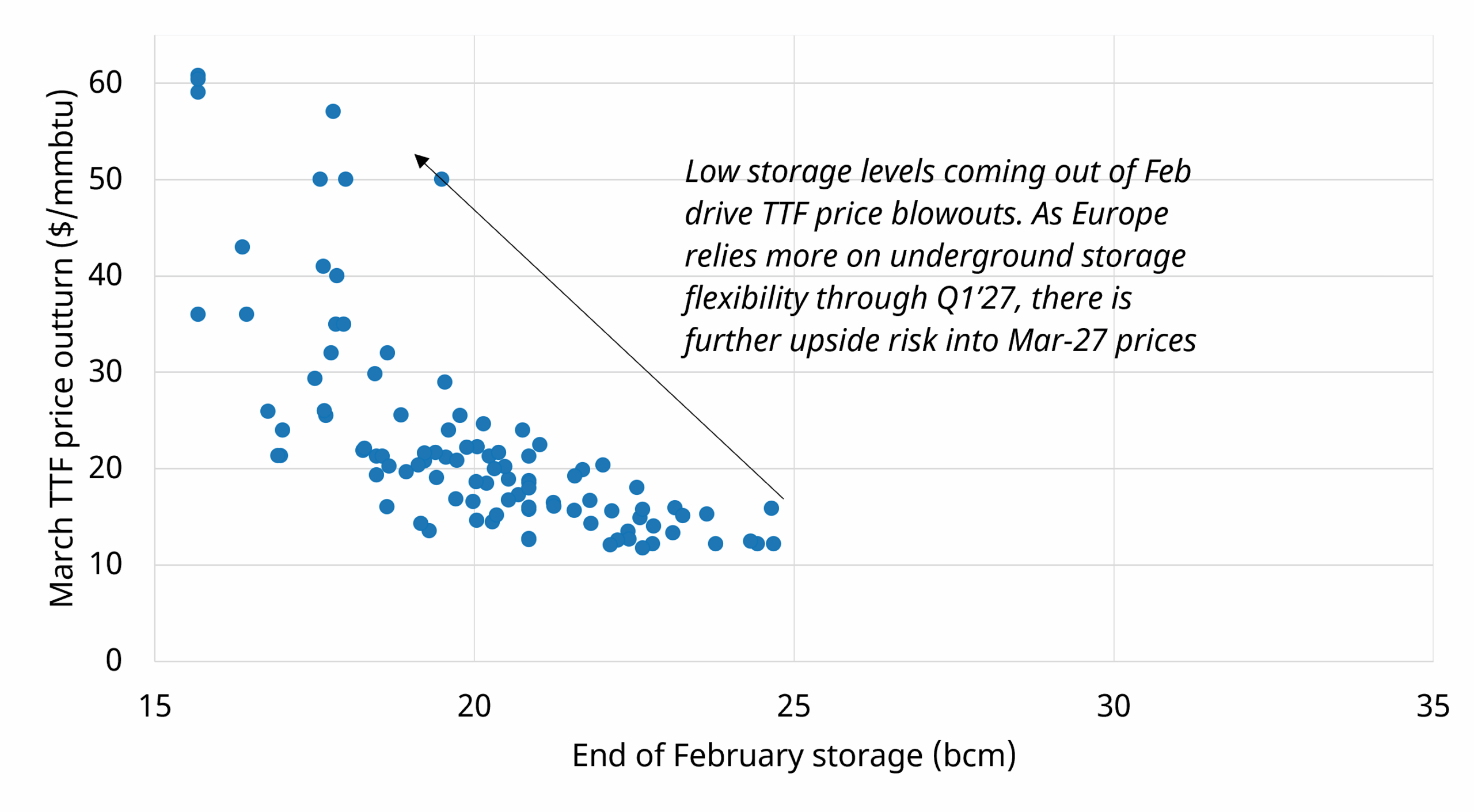
Chart 4 illustrates the relationship between end-February European storage volumes and modelled March TTF prices.
Chart 4: Modelled March 2027 TTF price versus end-February storage volumes
Source: Timera Global Gas Model. Stochastic scenarios capture uncertainty in weather, maintenance and commodity prices.
Lower stocks are associated with a much wider range of potential March prices, including substantial upside outturns. The risk therefore extends beyond a higher average winter price: tight balances can produce sharp late-winter price increases as storage flexibility diminishes.
Five risks to watch
- Hormuz reopening: Earlier reopening eases winter balances; prolonged disruption carries tightness into summer 2027.
- Winter weather: Mild temperatures reduce pressure. Simultaneous cold periods in Europe and Asia intensify competition for flexible LNG.
- Russian LNG disruption: Constraints on Yamal exports, including shipping availability and longer routes to Asian buyers, could further reduce supply.
- Asian demand response: Demand sensitivity above $20/mmbtu remains uncertain. Faster reductions ease the balance; more resilient imports support prices.
- Storage drawdown: Deeper withdrawals ease winter tightness but increase summer refill requirements. A higher practical minimum stock level has the opposite effect.
Our Q3 2026 short-term outlook explores winter 2026/27 and summer 2027 balances, demand flexibility and price risks in greater detail. Contact Kaan Cengiz (kaan.cengiz@timera-energy.com) to discuss the analysis.