TTF prices have retreated since their year-to-date high on 30 October, despite several signals that Europe’s winter gas balance remains exposed. Storage is shifting into withdrawal mode from a low starting inventory position, while LNG supply growth outside Qatar and the UAE has lost momentum. The parallel decline in Brent suggests wider market sentiment may be playing a part. For gas market participants, the question is whether prices are reflecting a genuine easing in the balance or a reduction in risk premium.
Prices have fallen along the forward curve
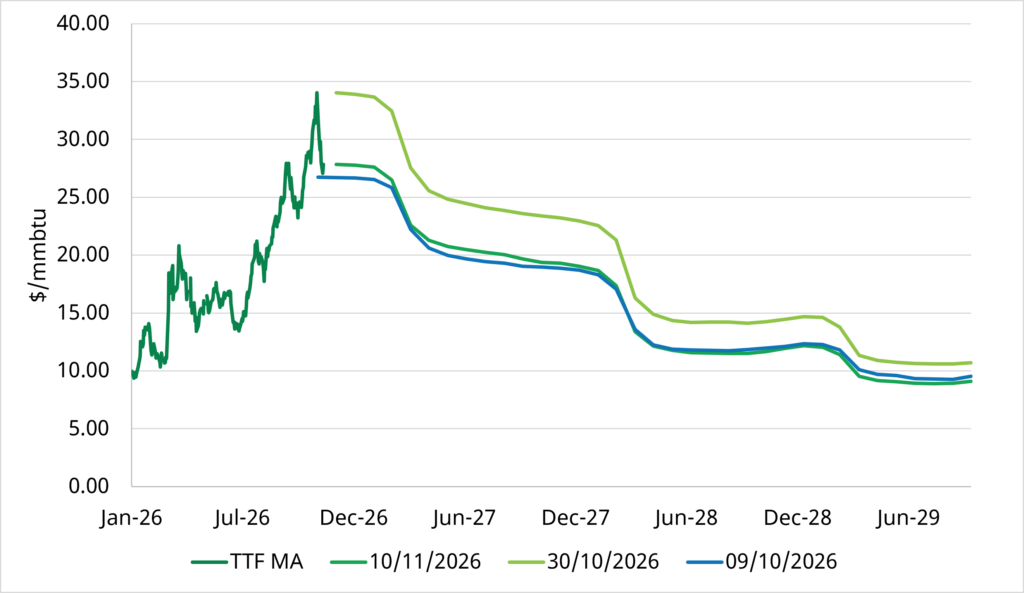
European gas prices have corrected from their late-October peak. Chart 1 compares the TTF price history and forward curves on selected dates. By 10 November, the forward curve was below its 30 October level across much of the delivery period, with the largest adjustment around the coming winter.
The scale of the move beyond the prompt market is consistent with a repricing of supply risk rather than a change confined to immediate physical conditions. However, the forward curve alone cannot identify the trigger.
Chart 1: TTF price history and forward curve repricing
Source: ICE, Timera Energy
Note: TTF price history and forward curves dated 9 October, 30 October and 10 November 2026; units $/MMBtu.
Oil has weakened too, but the drivers are unclear
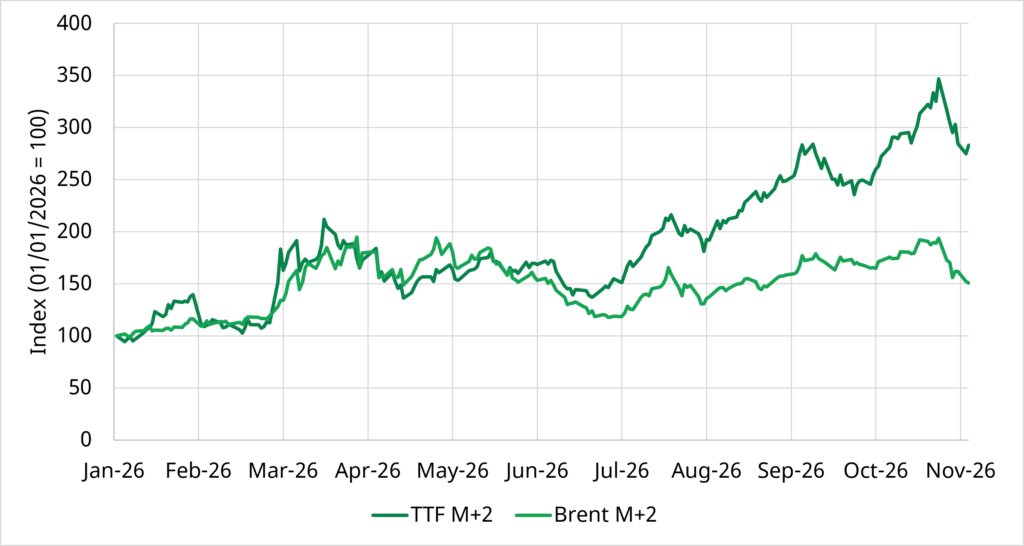
The correction was not isolated to gas. Chart 2 shows indexed TTF M+2 and Brent M+2 both falling from their October highs into November. The moves coincided with the period around the US midterm elections, but co-movement does not establish the cause.
Broader macro or geopolitical repricing, alongside profit-taking after the October rally, may help explain the move. TTF nevertheless remains much further above its start-of-year level than Brent, pointing to the different risk backdrop facing European gas.
Chart 2: TTF and Brent prices retreat from October highs
Source: ICE, Timera Energy
Note: TTF M+2 and Brent M+2 indexed to 1 January 2026 = 100.
Storage is moving into withdrawal mode
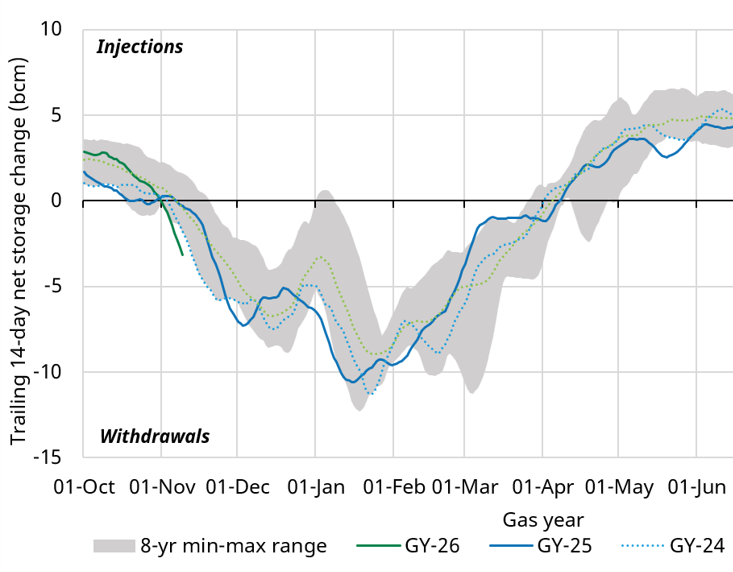
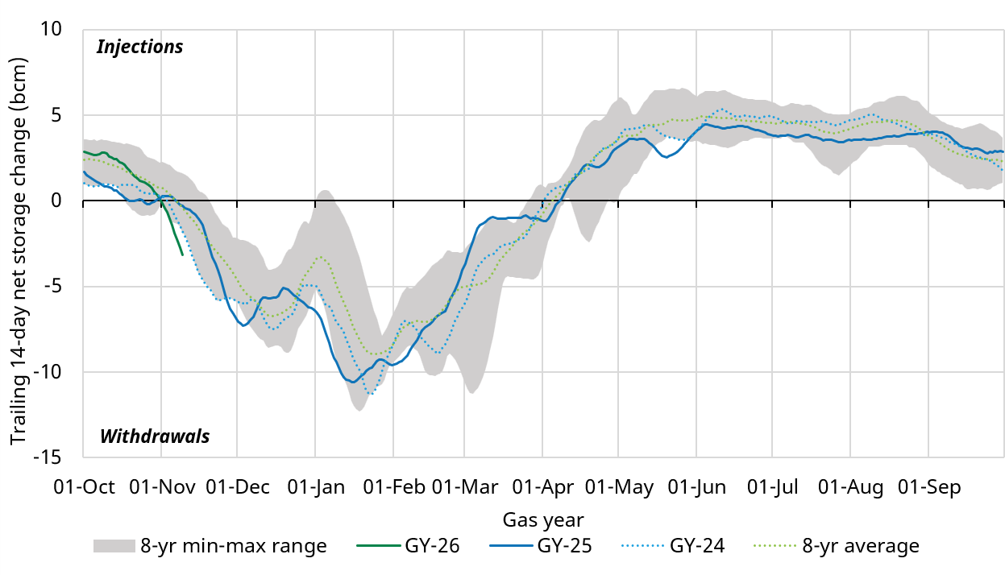
Physical conditions offer a contrasting signal. Chart 3 tracks the trailing 14-day net change in European gas storage across gas years. The 2026 line has moved rapidly from injections towards withdrawals in early November, marking the transition into winter demand.
That matters because Europe entered winter with inventories materially below normal. Sustained withdrawals would deepen the stock shortfall and increase the need to attract supply later in the season. The lower inventory buffer also leaves the market more exposed to cold weather or unexpected supply disruption.
Chart 3: European storage shifts towards withdrawals
Source: GIE (AGSI)
Note: Trailing 14-day net storage change (bcm), by gas year; negative values indicate withdrawals. Eight-year range and average as supplied.
LNG supply recovery remains uneven
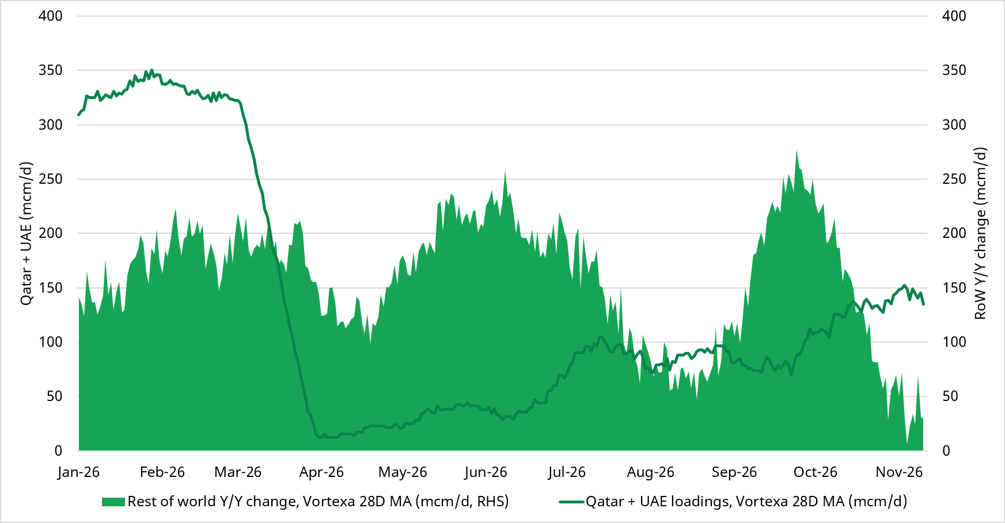
LNG supply is offering only partial relief. Chart 4 shows the recovery in Qatar and UAE loadings following their collapse earlier in 2026, alongside the year-on-year change in loadings from the rest of the world. Qatar and UAE loadings have recovered to their highest levels since that disruption, but rest-of-world supply growth has slowed sharply since September.
The underlying analysis identifies weaker loadings from Australia, Trinidad and Equatorial Guinea as offsets to year-on-year US growth. If that weakness persists, higher Gulf loadings will not necessarily translate into a material easing of the global LNG balance or Europe’s call on flexible cargoes.
Chart 4: Gulf loadings recover as wider LNG growth slows
Source: Vortexa
Note: 28-day moving averages. Qatar + UAE loadings (left axis) and rest-of-world year-on-year change (right axis), both in mcm/day.
Volatility remains central to winter exposure
Timera’s recent snapshot on TTF day-ahead volatility highlights how limited storage flexibility and reliance on marginal LNG cargoes can amplify short-term price moves. Lower flat prices need not imply lower volatility or less value in flexibility. For fast-cycle storage and flexible gas portfolios, the ability to respond to sudden price changes remains commercially important.
The price correction therefore sits awkwardly alongside storage and LNG indicators. Some risk premium may have been removed, but the winter balance remains sensitive to weather, supply disruptions and further shifts in market sentiment. Traders and asset owners need to distinguish outright price direction from volatility exposure.
If you would like any more information on European Gas Markets, or any more information on the work we do to support our clients, feel free to contact Luke Cottell (Associate Director) at luke.cottell@timera-energy.com.