EU methane rules: delayed, not resolved
The European Parliament’s 22 October vote in favour of delaying key EU methane import requirements by three years offers relief to LNG buyers facing a tight supply market. Disruption through the Strait of Hormuz and the scheduled January 2027 ban on Russian LNG under long-term contracts have sharpened immediate security-of-supply concerns. But the vote has not changed the overall requirements, and long-term LNG deals signed now will still face methane rules within their tenor.
The deadline may move, but the obligations remain
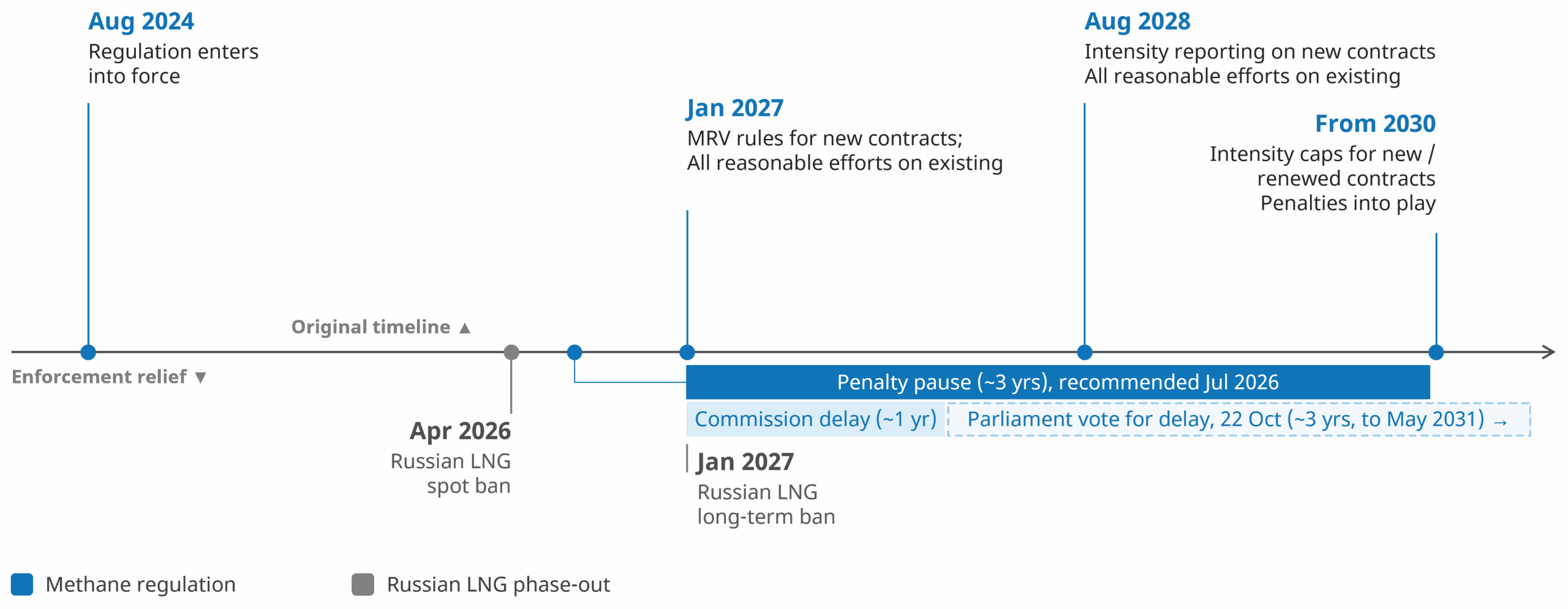
Under Parliament’s latest position, importers would have until 31 May 2031 to demonstrate equivalent methane monitoring, reporting and verification (MRV) for contracts signed or renewed since 4 August 2024, with first methane-intensity reports due by 5 August 2031. The Commission had proposed a one-year delay; Parliament has gone further. But the delay is not yet law: Parliament still needs to agree a text with the Council. Unless amended legislation is adopted in time, the original MRV requirement takes effect on 1 January 2027.
Chart 1 shows the original timetable, the proposed postponements and the separate Russian LNG phase-out.
Note: The chart distinguishes original deadlines from proposed postponements. The July 2026 recommendation for a penalty pause is not binding law.
Delaying the deadline does not unblock origination
In Timera’s Temporary Trough long-term scenario, European LNG imports are projected to grow from around 155 bcm to more than 200 bcm by 2030, with US LNG supplying about two-thirds of imports by then. This reliance on US supply complicates the picture: US Gulf Coast exports draw on co-mingled pipeline gas, making source-level MRV more difficult than for a dedicated upstream supply chain.
The regulatory delay buys time to agree credible verification arrangements; it does not itself provide them. If no workable route emerges, some volumes could struggle to meet EU requirements, restricting the pool of eligible LNG. In that scenario, compliant LNG could command a premium in Europe, while non-compliant cargoes might need to clear at lower prices in Asia. This could create a compliance-driven split in LNG pricing.
Exposure differs by contract structure. DES buyers acting as EU importers are directly exposed to upstream sourcing and documentation requirements. Buyers with FOB supply and regas capacity retain greater flexibility to divert LNG outside the EU or source compliant cargoes, but restrictions on European access would still impair portfolio optionality.
Legal responsibility and commercial leverage are different
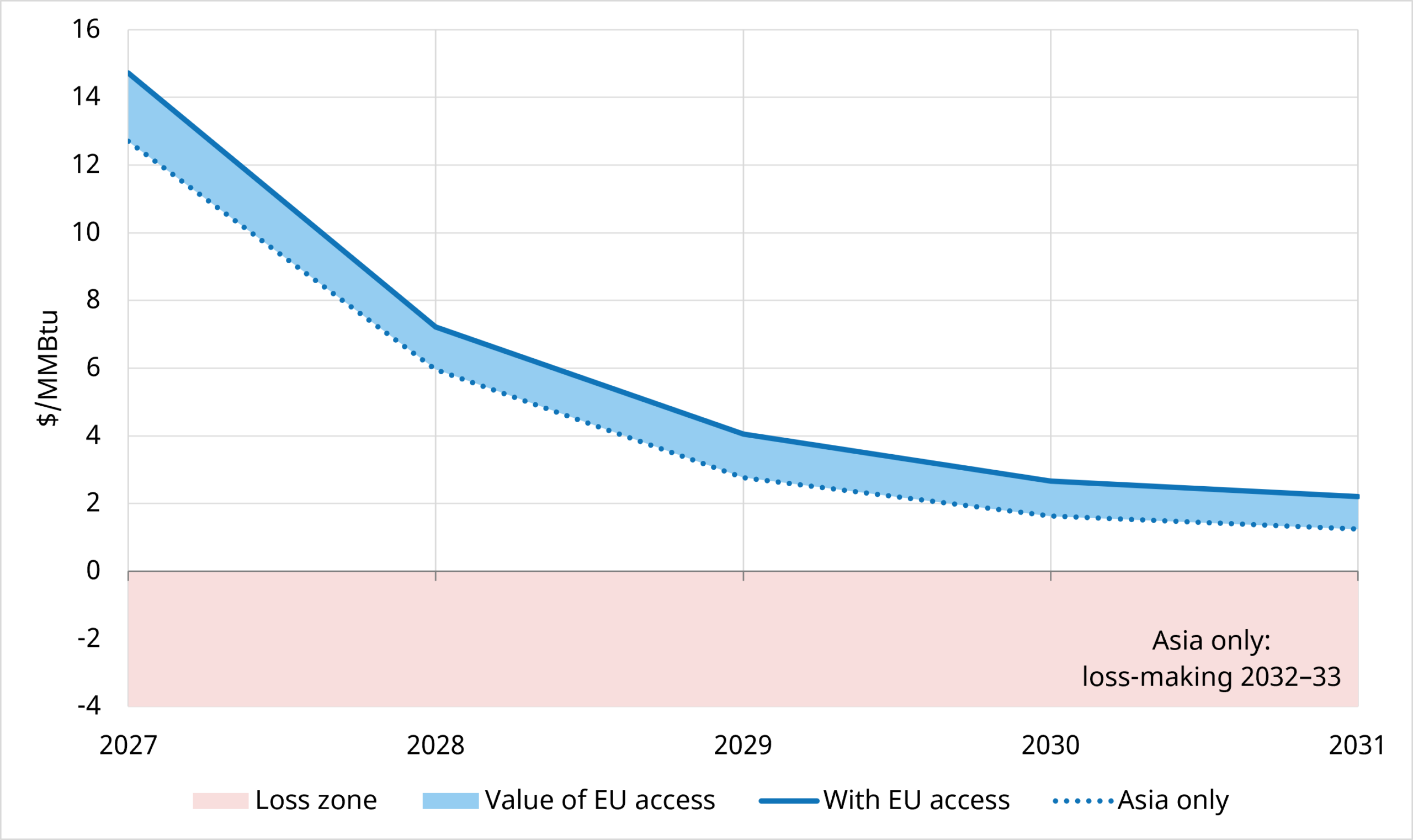
EU importers carry the legal responsibility for demonstrating compliance. Today’s tight market can also leave them bearing much of the commercial burden. Chart 2 shows why that balance may change: for a modelled US Gulf Coast FOB position, access to Europe adds roughly $1–2/MMBtu of value through 2031, under a backwardated futures curve.
Chart 2: Modelled value of EU market access for US Gulf Coast LNG
Source: Timera Energy, LNG Bridge model
Note: 1 mtpa FOB USGC, 115% HH linkage; fixed fee sunk; no cancellation rights; spot shipping. Mean of 250 stochastic runs at 5 October 2026 futures prices; “Asia only” excludes European access.
The modelled $/MMBtu return falls sharply over 2027–2031, but the EU-access premium remains material relative to the remaining margin, reflecting the option to deliver into Europe when market spreads favour it.
For sellers, credible MRV data may therefore become a competitive advantage in preserving European access, which becomes more important relative to remaining margin as the market loosens. While the legal duty stays with the importer, the commercial incentive to provide compliance-ready supply can shift upstream as market conditions soften.
Contract for the rules, not just the deadline
Contracts agreed now should address MRV data, verification responsibilities and the consequences of restrictions on EU delivery rather than wait for legislation to be finalised. A three-year delay reduces immediate pressure; it does not remove the commercial exposure or settle how that burden will be shared.
For any questions around the commercial implications on LNG portfolios or assets, reach out to David Duncan (david.duncan@timera-energy.com).