Capacity agreements give flexible power assets a more predictable revenue stream alongside wholesale market earnings. Capacity payments can often be the portion of the flex asset revenue stack that makes or breaks an investment case.
Recent German and Belgian capacity auctions shed light on which technologies are being ‘bought’ to provide incremental flexibility. They also provide an insight into investor’s marginal return requirements to commit capital into new flex assets.
Germany awarded 5.2 GW of de-rated capacity to gas in its first long-term tender, at a weighted average of about €155,000/MW/year. In Belgium’s four-year-ahead auction for 2030–31, new batteries secured 483 MW of the 769 MW awarded. The Belgian auction averaged about €18,000/MW/year. Germany paid more than eight times this to incentivise the dispatchable thermal flex it needs to enable the retirement of coal assets.
RWE and LEAG secured 10 of the 11 awards in Germany’s first long-term capacity auction, including LEAG’s Leipheim project. Stadtwerke Karlsruhe secured the remaining award. In Belgium’s 2030–31 auction, GIGA Green Turtle led the new battery awards with 221 MW, followed by MVA-Project Co. 4 (94 MW) and Eneco Wind Belgium (86 MW), all on a de-rated basis.
A tale of two auctions
Belgium’s four-year-ahead auction was a top-up. The country had already contracted around 1.6 GW of new gas in 2021 on 15-year contracts and extended the lives of two nuclear reactors. The latest round procured a small residual volume after allowing for capacity already contracted or expected to remain on the market.
Germany is procuring the firm capacity it will need as coal and lignite capacity phases out by 2038. In doing so it needs dispatchable energy not just shorter duration storage. Germany’s nuclear plants have already closed, and we estimate that around 20 GW of coal and lignite capacity will still need to close after 2030. Germany’s two long-term auctions target 9 GW of de-rated capacity on 15-year contracts.
German scarcity lasts longer
Our analysis of hourly data from ENTSO-E’s European Resource Adequacy Assessment (ERAA 2025) shows how scarcity could differ in 2030. Chart 1 shows that about half of Germany’s modelled scarcity events last five to ten hours. Around 40% of Belgium’s last one or two hours, a duration well suited to four-hour batteries.
Chart 1: Duration of modelled scarcity events in Germany and Belgium in 2030
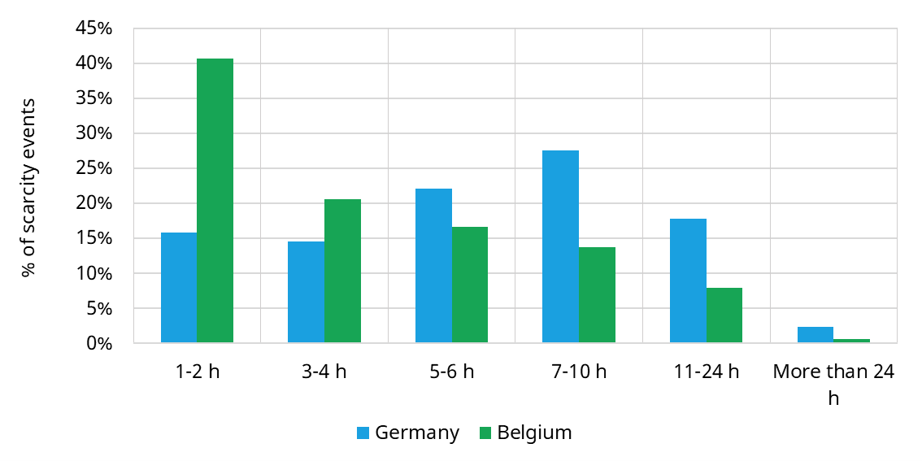
Source: Timera, ENTSO-E (ERAA 2025). Shares are measured against the total number of modelled scarcity events in each country.
Longer events account for most of Germany’s shortfall
Chart 2 adds the energy dimension. Modelled shortfalls average about 88 GWh a year in Germany and 5 GWh in Belgium. Events lasting more than ten hours account for around 60% of the German shortfall and 43% of the Belgian shortfall. Germany needs resources that can sustain delivery through long periods of low renewable output and high demand.
Chart 2: Modelled energy shortfall by event duration in Germany and Belgium in 2030
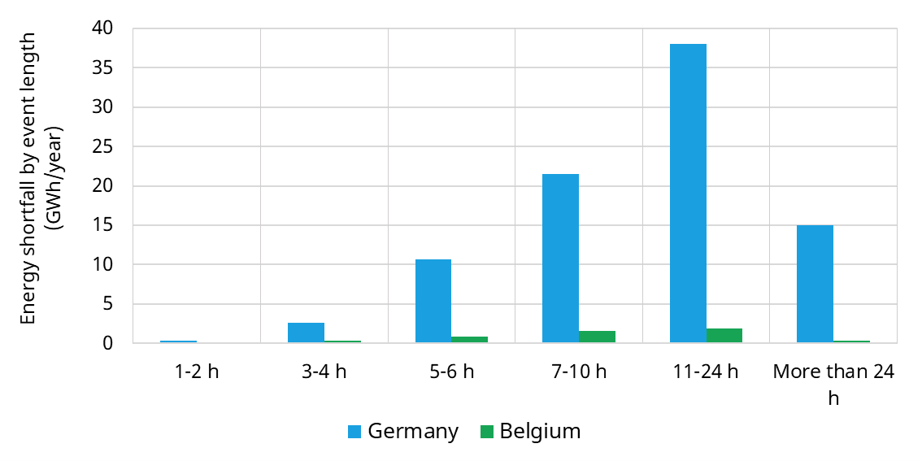
Source: Timera, ENTSO-E (ERAA 2025)
A fully charged 4-hour battery can average only a third of its rated output over a 12-hour event if it has no opportunity to recharge. Germany’s long-term tenders address that kind of risk by requiring plants to deliver 80% of installed power for at least ten consecutive hours. Storage must be ready to repeat the delivery within three hours.
Restoring that much energy in three hours would require average charging power of about 2.7 times installed discharge power before losses. That is a demanding grid connection requirement for a battery that can meet the ten-hour threshold. The duration threshold itself puts conventional 4-hour batteries out of contention for this product.
What if Germany bought batteries instead?
We tested a scenario (Counterfactual) that swaps the 9 GW of de-rated gas assumed across Germany’s long-term procurement programme for batteries. For scale, at a 50% de-rating factor, 4-hour batteries would need 18 GW of installed power and 72 GWh of storage to replace that volume.
Chart 3 compares the annual energy balance with our Central case. Higher net imports broadly offset the fall in German gas generation in each year shown. The scenario also shows less curtailment. Batteries discharge less energy over the year than they draw to charge.
Chart 3: Germany’s annual energy balance versus the Central case, 2032–2042
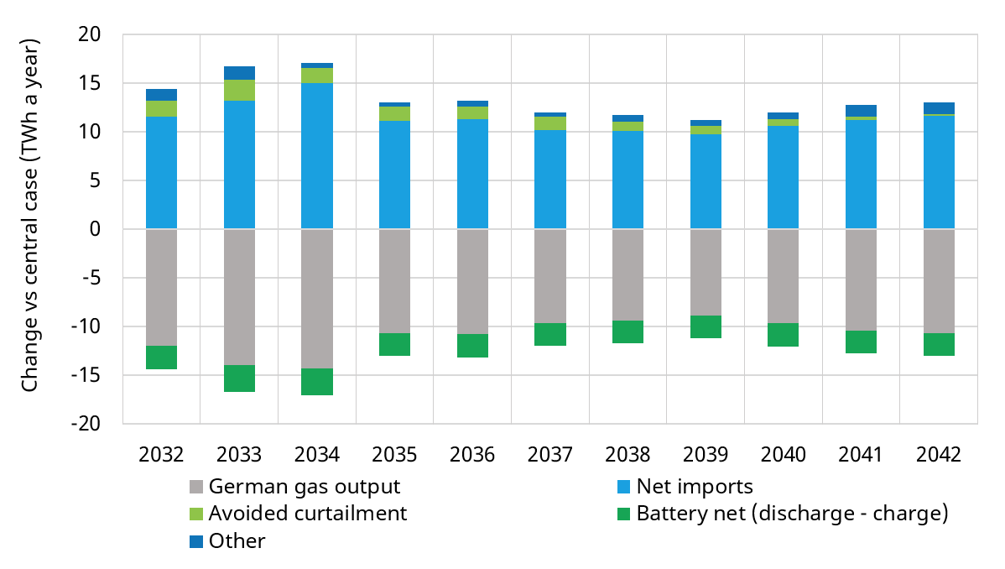
Source: Timera Market Model
The Counterfactual removes about 10.6 GW of installed gas capacity (9 GW de-rated at 0.85), pro rata across new-build combined- and open-cycle gas turbines from November 2031. Battery net is discharge less charging, in TWh a year.
Higher gas generation abroad amounts to 15–38% of the lost German gas output, depending on the year. Most of that additional gas generation is in the Netherlands, France, Belgium and Poland. Higher nuclear output, mainly in France, supplies most of the remaining increase in imports. The annual balance shows a shift towards imports.
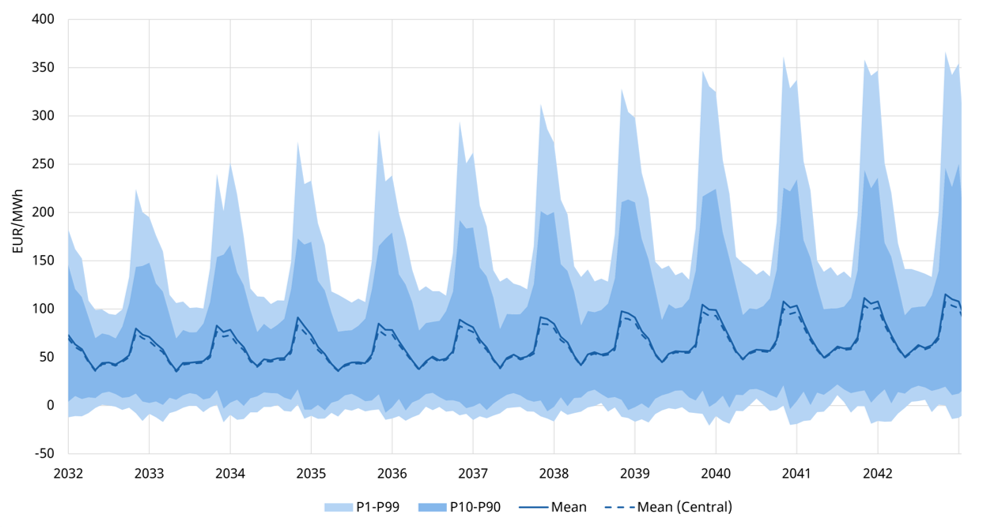
In Charts 4 & 5 below we show the change in the day ahead power price distribution across the Central and Counterfactual scenarios. This reinforces the structural requirement for new firm dispatchable capacity; especially during winters in Germany.
Chart 4: Central case day ahead power price distribution, 2032 – 2042 Central case
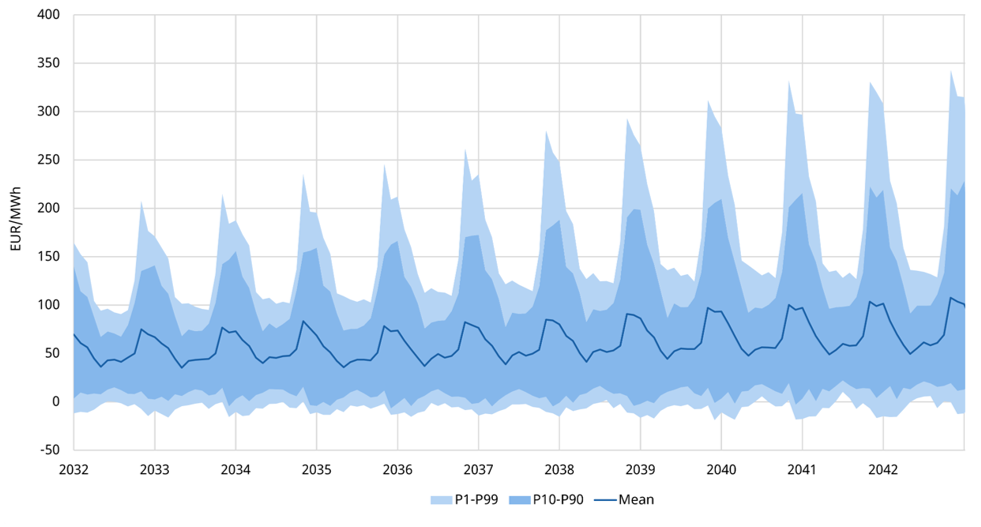
Source: Timera Market Model
Chart 5: Day ahead power price distribution, Counterfactual case
Source: Timera Market Model
This BESS replacement case comes with higher price volatility as Germany loses its dispatchable response, particularly in periods of low wind and solar output. This is evident when looking at the upper tail of the distribution; the Counterfactual case has materially higher winter peak prices than the Central case. On an mean basis, winters also become more expensive in the absence of gas; summer prices remain similar.
As evidenced above, Germany also becomes more dependent on imported flexibility via interconnectors, increasing vulnerability to correlated shocks across other neighbouring markets. Market conditions like this are difficult to digest from a policy and security of supply perspective.
BESS build out is playing a key role in balancing wind and solar output over short to medium durations. However as Germany retires its coal fleet, it still needs dispatchable gas plants to sustain energy output through prolonged periods of low wind and solar output.
Article developed by Davied Mak (Analyst) – feel free to reach out to Davied if you are interested in more details on our power analysis and services (davied.mak@timera-energy.com ).