Italy’s gas cap
On 16 October Rome and the European Commission reached a preliminary political agreement on Article 6 of DL Bollette. Italy will be allowed to place a temporary cap of around €60/MWh on the gas price paid by gas-fired generators. The preliminary agreement would allow Italy to implement the cap in January 2027 and keep it in place for 12 to 18 months. ARERA has also confirmed progress on the TTF-PSV ‘gas liquidity service’ under Article 10, covered in last week’s snapshot.
Two measures acting on system marginal price
Both the gas price cap for power generators and the liquidity service target the marginal price unit. The gas price cap lets gas-fired units bid into the day-ahead market at a conventional expected gas price of ~€60/MWh, with the gap to PSV refunded and funded first from cross-border congestion rents. The liquidity service pays importers a fixed premium for incremental Gries Pass volume priced at no more than TTF plus a fee capped at €0.50/MWh, funded with €200m from strategic storage sales.
The common logic is leverage. The marginal supplier sets the price for the wider market, meaning a relatively small subsidy can have a much larger impact on prices. Reimbursing the marginal CCGT lowers the price for all electricity consumption, while subsidising marginal gas imports reduces PSV prices for all gas consumers. However, these benefits depend on demand not responding strongly enough to push prices back up. Given current gas market expectations, some degree of market distortion in Italy during 2027 appears unavoidable.
Why Italy is not Iberia
The 2022 Iberian cap worked without major distortion because the peninsula was close to an electrical and gas island, insulated from rest of Europe’s acute regas capacity constraints at the time. Italy is instead highly intertwined with European gas and power markets. With TTF around €90/MWh, a €60 cap makes Italian CCGTs the cheapest thermal plant in the region, risking reversed power flows and gas market distortions, with Italian consumers subsidising more domestic gas generation than an undistorted market would deliver.
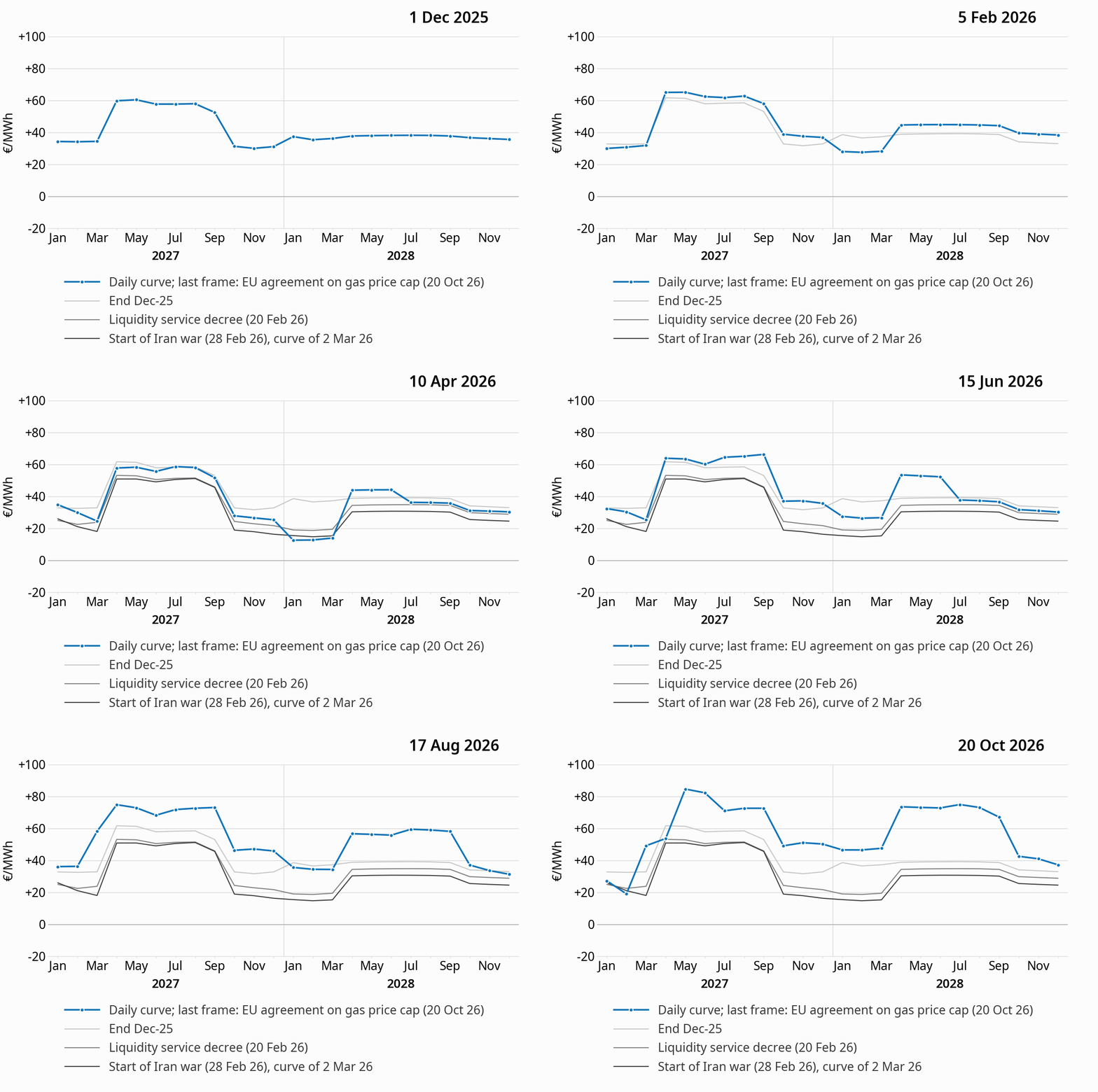
ARERA’s safeguards target exactly this: the cap can be reset monthly so it does not sit far below market gas prices, and is monitored against power price differentials with France, Austria and Slovenia. Chart 1 shows the forward market has not priced an Italy–France spread inversion for 2027–2028 since DL Bollette was released in early 2026.
Chart 1: Italy–France base power forward spread, 2027–2028
Source: ICE, Timera Energy
What our modelling shows
We ran our stochastic Pan-European power and global Gas & LNG models across the inherent uncertainty of 2027, with a €60/MWh cap on the gas price faced by Italian plants. Results are conditioned on current commodity forwards and would shift materially under a different price outlook that a shift in the Middle East crisis could cause. Chart 2 shows the expected monthly change in the main price signals.
Chart 2: expected change in Italian power market outcomes in 2027 with the gas cap
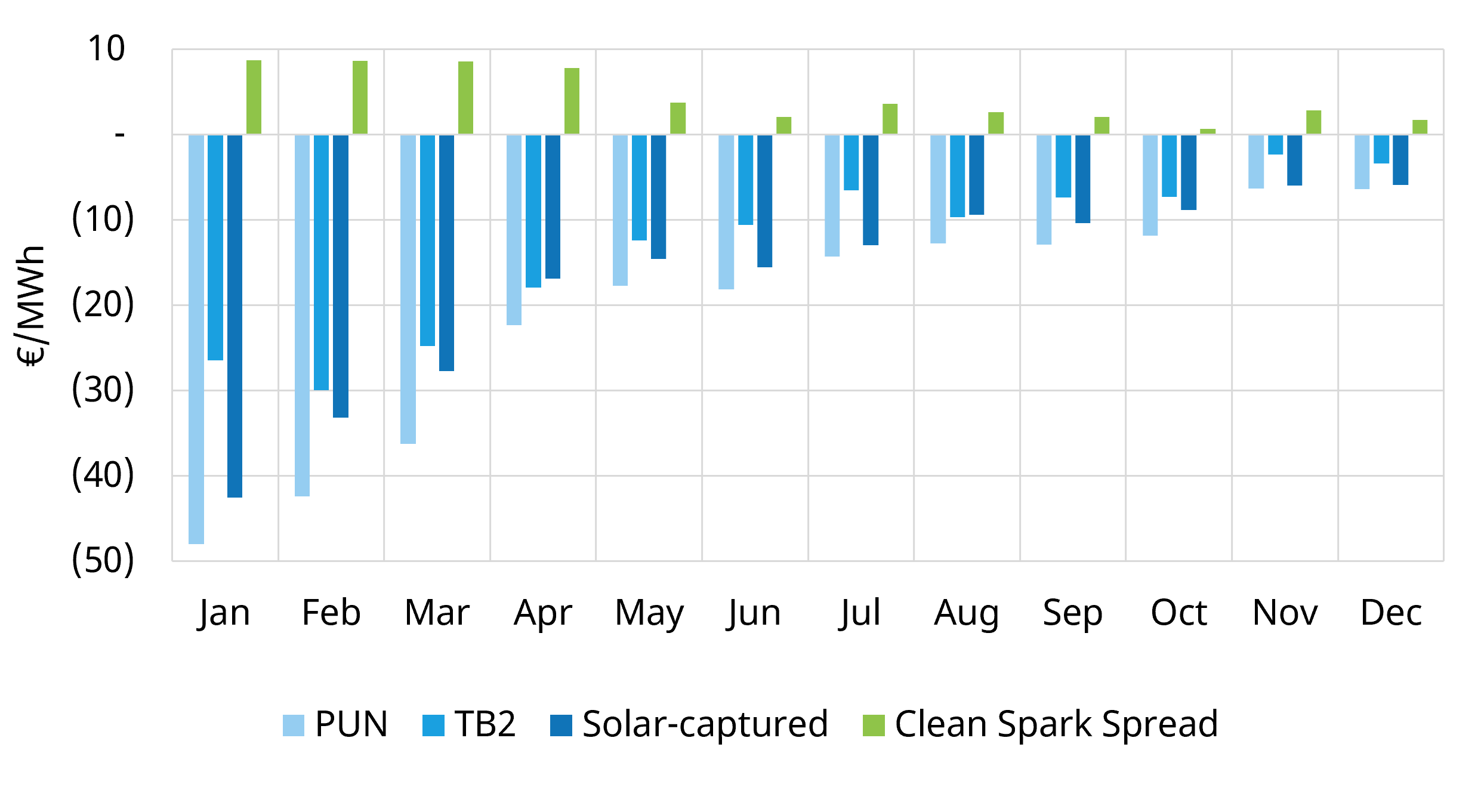
Source: Timera Energy stochastic Pan-European power market modelling assessed on 21st October 2026. TB2 is the Top-to-Bottom product for 2 hours measuring the daily spread between the average of the 8 highest and 8 lowest 15-minute Day-Ahead price intervals.
The headline is a baseload Italian price (PUN) around ~€20/MWh lower on average across 2027, front-loaded in the first quarter where the TTF–cap gap is widest (around €48/MWh in January). Thanks to the leverage discussed above, this more than offsets the subsidy cost, but at the expense of higher domestic gas burn. Chart 3 shows incremental Italian gas imports of just over 2 bcm in 2027, mostly in the first quarter, against a net increase in all European gas-for-power demand of around 1 bcm, as Italian generation displaces gas generation elsewhere.
Chart 3: expected change in Italian gas imports and European gas demand in 2027 with the gas cap
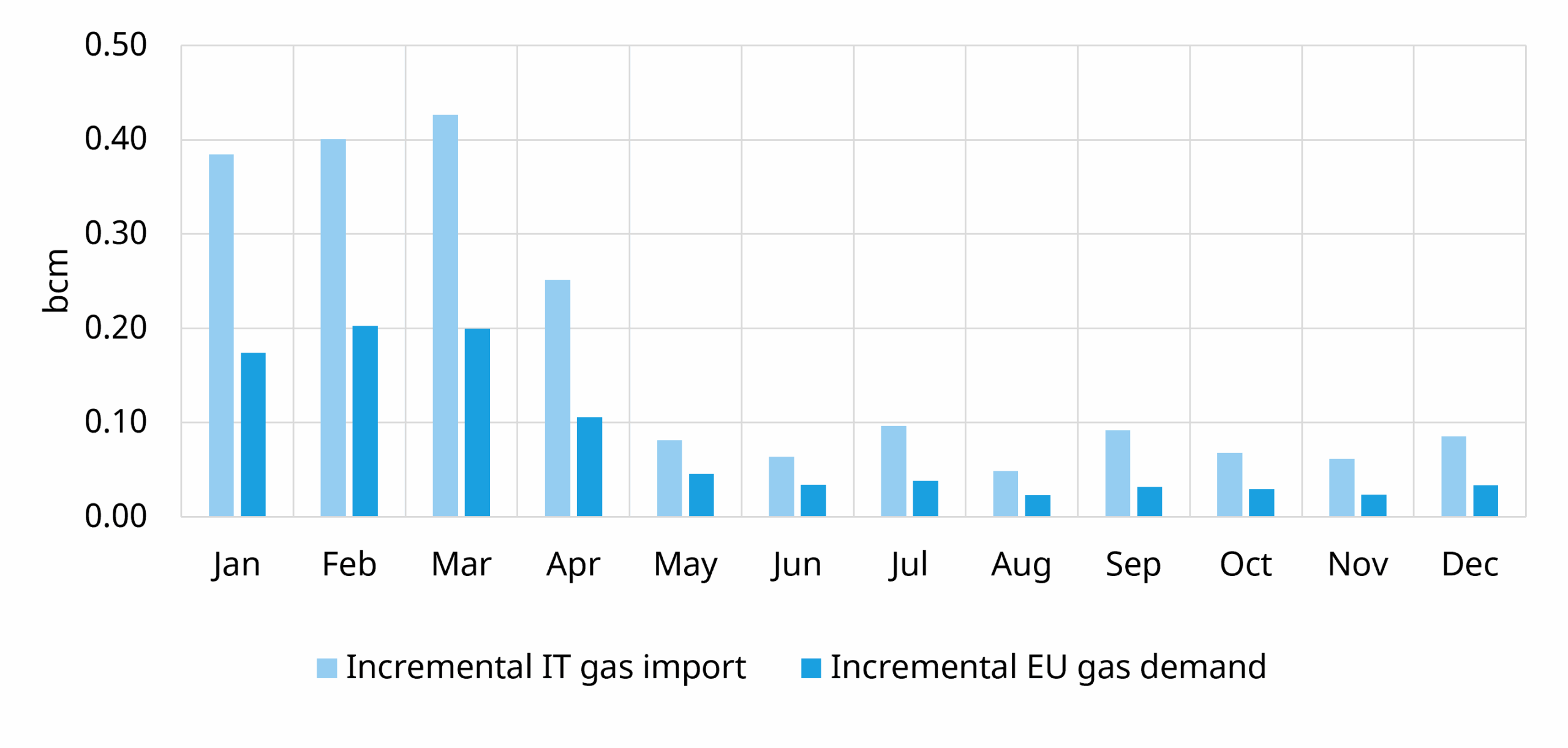
Source: Timera Energy stochastic Pan-European power market and global Gas & LNG stochastic market modelling, assessed on 21st October 2026.
Higher Italian gas power generation pulls less efficient plants to the margin and raises the opportunity cost of upward flexible reserve, while the TTF-cap spread reduces competitive pressure from neighbouring markets. The result is a higher clean spark spread (CSS), up more than €5/MWh on average in 2027 and €8–10/MWh in the first quarter.
Forwards point the same way: Chart 4 shows the 20 October CSS curve with PSV capped at €60/MWh, giving January and February 2027 spreads above anything priced in recent months. We expect realised CSS to fall short of forwards, as ARERA is likely to scrutinise marginal price formation closely when the measure is fully implemented.
Inframarginal technologies like BESS and RES lose most. The Top-to-Bottom 2 (TB2) spread falls by about €13/MWh on average and by €25–30/MWh in the first quarter; the solar captured price falls by about €16/MWh across 2027. On the gas side, extra imports add an average of ~€0.5/MWh to the PSV–TTF spread through 2027, roughly what the liquidity service is designed to contain, so the two measures partly offset each other; the net effect also depends on how LNG supply responds to a thinner PSV–TTF spread.
Chart 4: Italian clean spark spread forward curve, 2027–2028, with and without a €60/MWh PSV cap
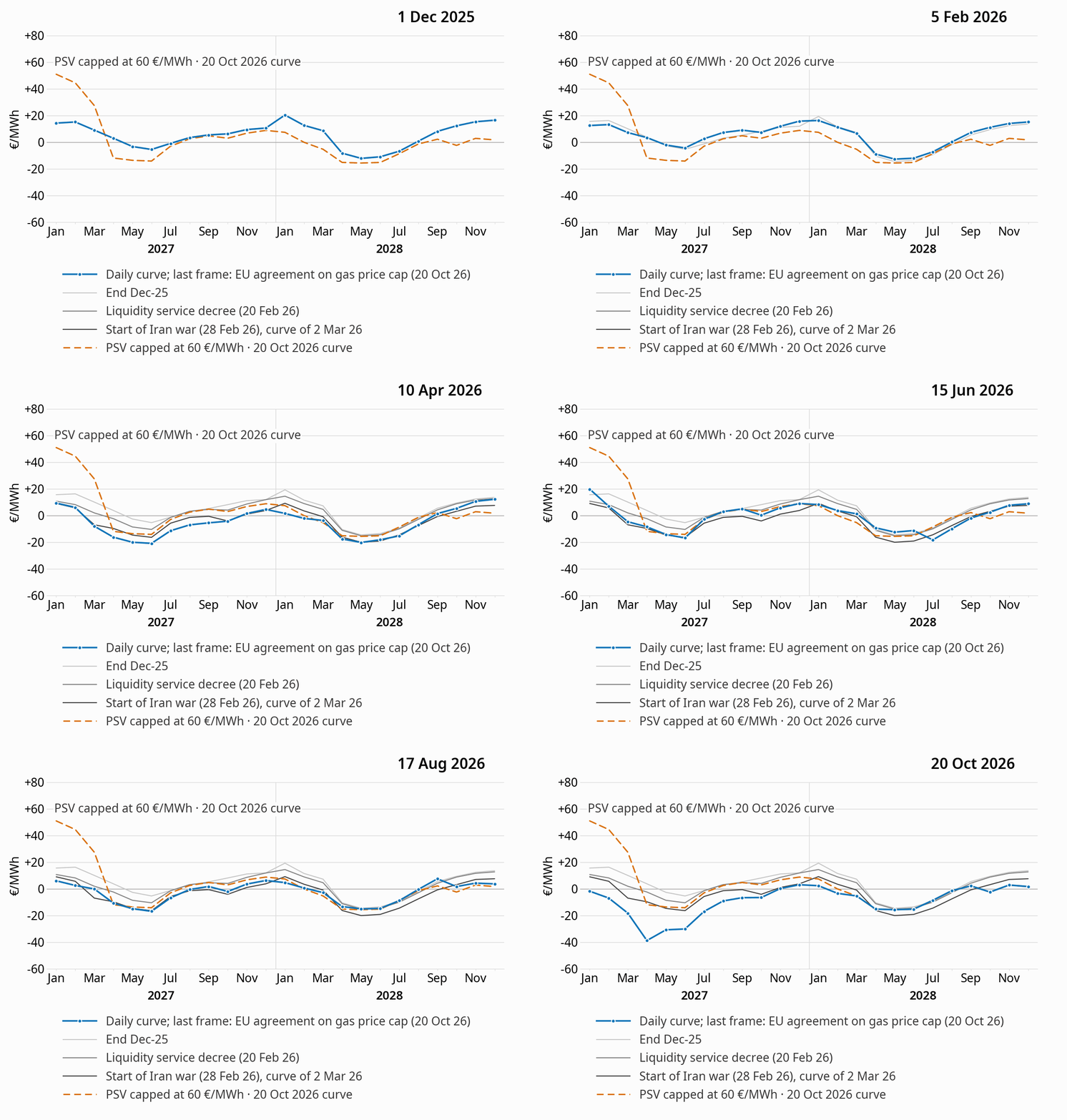
Source: ICE, Timera Energy. The dashed line is the 20th Oct 2026 forward curve recomputed with PSV capped at 60€/MWh
Why the consumer benefit is limited
Timera expects that the policies will create a limited benefit to consumers. Our estimates suggest only a fraction of energy price reduction will reach consumers per MWh of demand; the rest is eroded by:
- funding both measures: the gas cap from interconnector congestion and dispatching incomes, the liquidity service from storage gas proceeds;
- lower congestion income on the northern borders as cross-border spreads thin;
- a higher net cost of RES CfDs, as captured prices fall;
- the cost of passing the benefit to all customers, including those not exposed to merchant prices;
- a higher risk profile for RES and BESS offtake contracts, whose development remains the only feasible medium-term solution to Italy’s energy crisis.
Until now, most market participants priced a low probability of DL Bollette implementation on derivative prices. With political agreement now in place, the practical questions are how much is already in the 2027 forward curve, how the cross-border safeguard is drafted, and how much the mechanism will be amended while in operation.
Takeaways
The risk adjusted expected value of Italian energy portfolios is continuously evolving, and political intervention is only one driver alongside MACSE and Capacity Market auctions, ambitious nuclear plans, upcoming FER-X and FER-Z auctions, European power market platform integration, the FCR market launch and new TSOs and policy scenarios.
Timera supports clients on Italian power and gas investment, pricing, asset valuation and hedging. To discuss how we can help you navigate the complexity of this market, contact alessio.cunico@timera-energy.com (Director of Analytics).