GB LDES adds pressure but 4hr BESS remains attractive
Long duration energy storage (LDES) is set to add substantial capacity to the GB power market. For battery investors, the scale of this expansion raises questions about future trading margins. Yet the duration of the new capacity helps explain why the impact on four-hour battery energy storage systems (BESS) may be more contained than the headline volumes suggest.
A larger and longer duration pipeline
The LDES tender has selected 7.7GW of capacity, comprising 3.9GW of pumped hydro energy storage (PHES) and 3.8GW of BESS. Selected projects range from eight to 22 hours, with a capacity-weighted average of around 18 hours. The outcome favours longer duration projects and locations in northern Scotland, reflecting perceived system benefits.
The market had already anticipated LDES investment. Expectations for batteries had centred on eight-hour systems, alongside some longer duration portfolios, notably Field’s at around 16 hours. The selected volumes nevertheless sit at the upper end of expectations.
Timera’s house scenario assumes 2.2GW of new PHES and 3.6GW of LDES BESS from this pipeline, allowing for development attrition. In our high build out sensitivity, we assess the impact of all the selected PHES projects being delivered, effectively increasing the LDES capacity by 1.7GW in the 2030s. Chart 1, below, shows how this capacity is built out under our Timera Central scenario and our higher LDES sensitivity.
Chart 1: GB storage capacity assumptions and sensitivity
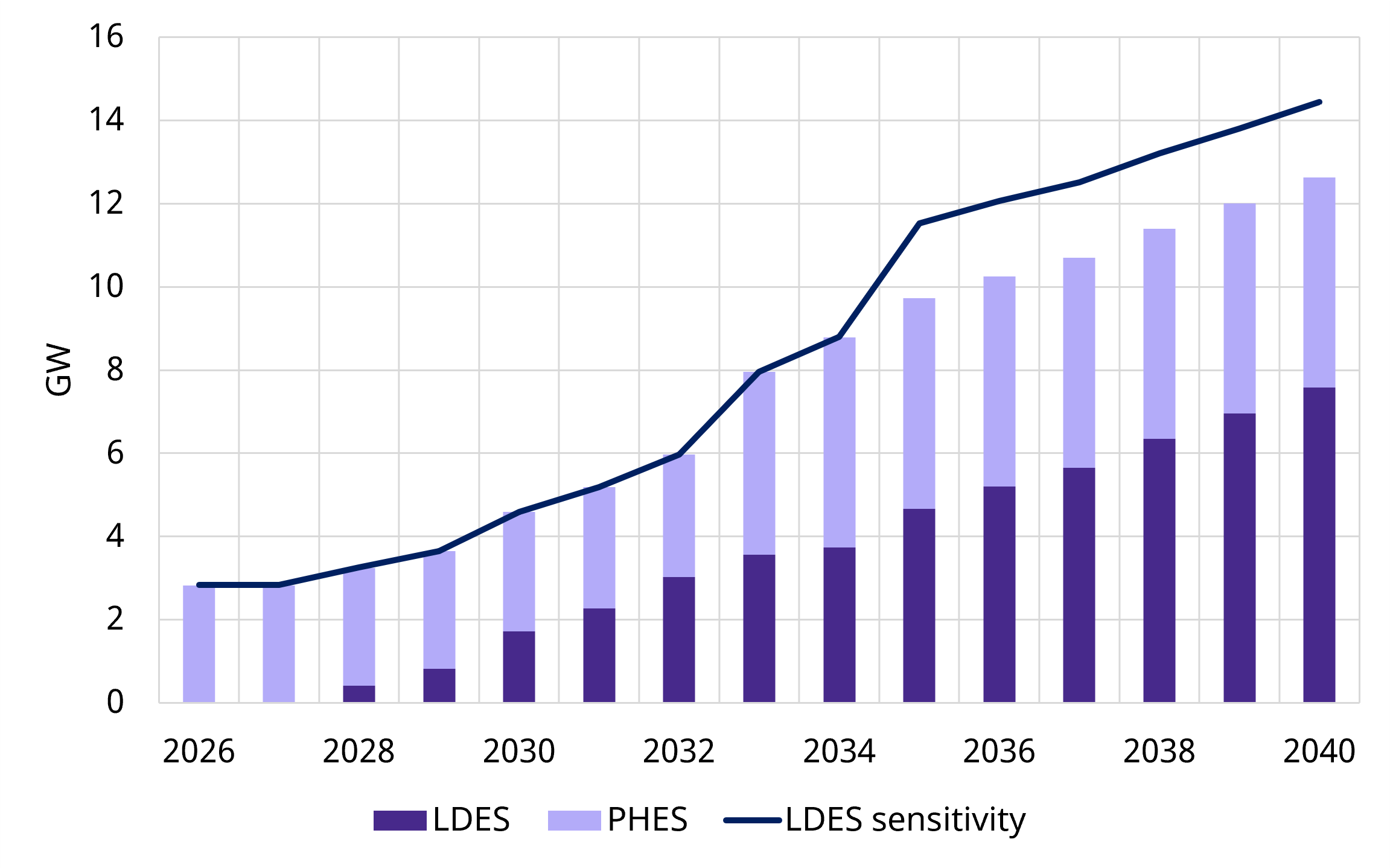
Source: Timera, Note: Supplied Excel chart, 2026–2040; GW. Bars show LDES and total PHES; the line shows the supplied sensitivity. Scenario scope requires reconciliation before publication.
Pressure on margins remains manageable
The sensitivity result set out in our analysis indicates a 5% reduction in energy margins for a benchmark 4hr BESS across the 2030s, with the impact concentrated in day-ahead trading. This reduces value, but the analysis still points to an attractive investment case for four-hour BESS where developers achieve competitive capital costs and strong operational performance.
The result measures the incremental pressure relative to a house scenario that already includes substantial LDES development. It should therefore be read in the context of the storage build already embedded in the base case.
Why duration changes the competitive impact
Competitive pressure depends on how storage operates. On most days, an eight-hour battery can follow a similar charging and discharging pattern to a four-hour system because both respond to the same day-ahead price shape. In this analysis, opportunities to shift energy between days play a limited role across the year.
Additional discharge capacity in GW therefore has a greater influence on typical four-hour BESS trading margins than additional storage duration at a given GW capacity. Longer duration systems add energy storage, but their extra hours need not translate into a proportionate increase in competition during the daily trading windows that underpin shorter duration battery value.
This also helps explain the need for support for longer duration projects: market price signals alone may not remunerate the additional investment sufficiently. A substantial share of capital is committed to extending duration, with a more limited impact on everyday BESS trading margins.
Illustratively, the estimated £9–13bn investment in the LDES tender could fund up to 22GW of four-hour BESS instead, setting aside grid connections and queues. That alternative would add substantially more discharge capacity and could exert greater pressure on trading margins. This is a comparison of capital allocation, rather than a forecast of feasible deployment.
Implications for investors
Falling cell prices strengthen the incentive to extend battery duration and extract more value from existing grid connections and development opportunities. For owners of shorter duration assets, investment directed towards extra hours can soften the margin compression associated with each additional pound invested in storage.
LDES still adds competitive pressure. However, its effect on four-hour BESS value depends on the capacity delivered and how the additional duration is used. Our analysis continues to support four-hour investment where capital costs and operational performance are competitive.
We explore LDES further in our Q3 GB BESS report, available through Timera’s subscription service. For further details, contact Arshpreet Dhatt (arshpreet.dhatt@timera-energy.com).