European network operators are entering their heaviest investment cycle in decades, and the cost is landing in grid fees. In Great Britain alone, total TNUoS revenue to be recovered is forecast to rise from £8.9bn in 2026/27 to £13.6bn by 2030/31.
Batteries sit awkwardly inside that recovery. They are consumers when charging and generators when discharging, and in several markets they were exempted from grid fees on the basis that they relieve the congestion the investment is meant to fix. That era is now ending. Germany has confirmed its exemption will expire. Belgium is also withdrawing its exemption. The Netherlands to the contrary has never offered one.
Developers have tended to treat this as a binary risk: exempt or non-exempt. However, what will now determine the impact on returns is the structure of the charge, not its existence.
A common direction of travel is starting to take shape
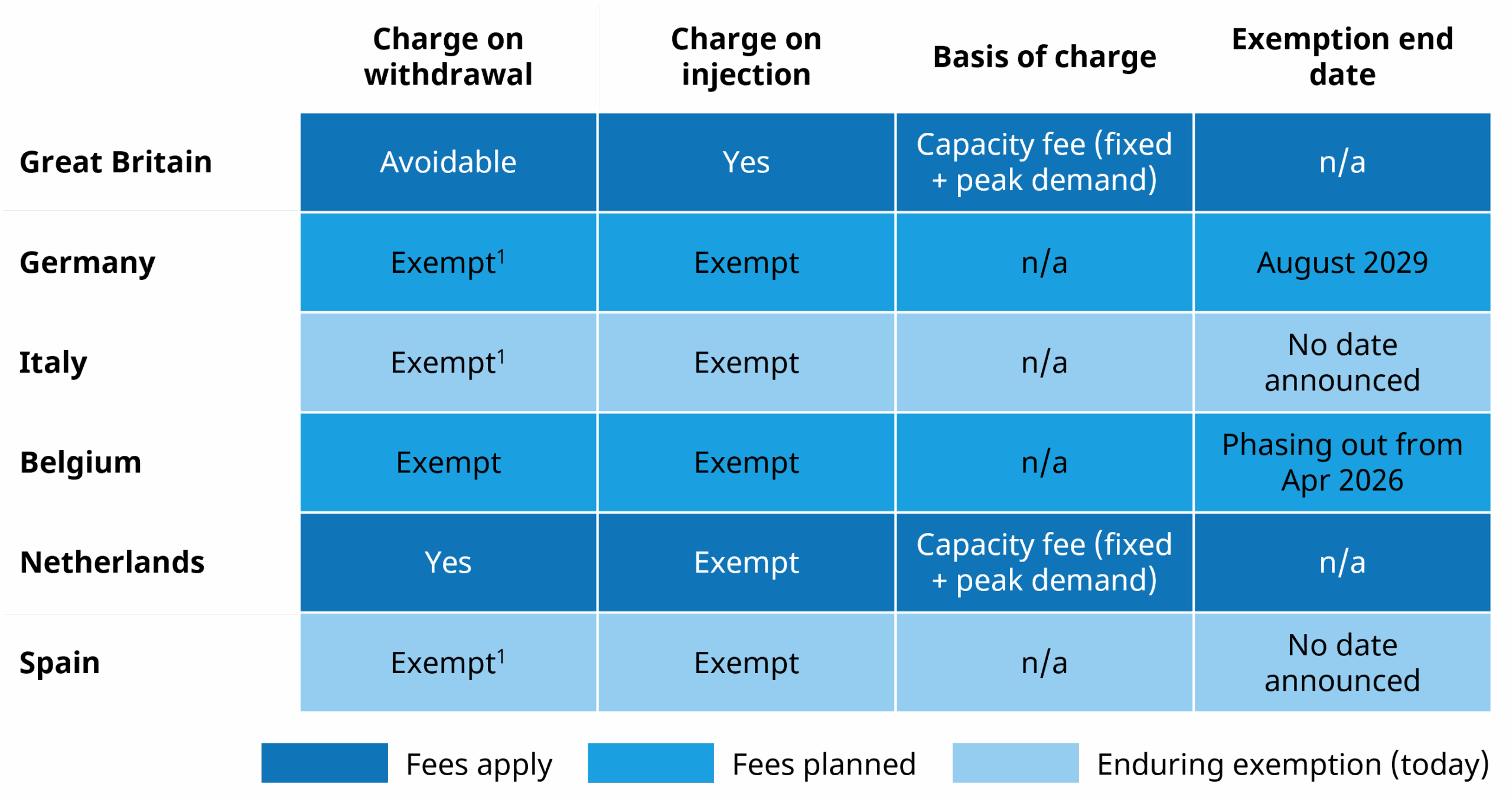
In this article we examine six markets that, as of August 2026, still offer broad fee exemptions for any developers able to overcome lengthy connection processes and commission assets. These exemptions are more frequently coming with conditions such as securing a grid connection or final investment decision by a certain date, which serves as an interim step to the exemption being removed. In the table below, we outline the current state of play across these markets.
1Exemption only applies to re-discharged energy; auxiliary consumption subject to fees.
Regulators across Europe are increasingly taking the view that storage should be treated like all other grid users, on the grounds that storage does still drive grid costs and that a blanket exemption creates no incentive for grid-friendly behaviour. When we explore these six markets in more detail, design decisions start to emerge that appear distinct but aim to solve the same problems.
Great Britain: scaling even without an exemption
GB has no blanket storage exemption, and has still built the deepest battery fleet in Europe. The mechanism for transmission-connected assets centres around generation TNUoS, a charge signal that is locational and zonal, and can in some demand-constrained zones offer an upside for battery storage.
GB is the working demonstration that an exemption is not a precondition for deployment, provided charges can be managed through siting and dispatch. It is also a warning; with transmission charges rising steeply into RIIO-ET3, the pot that batteries may eventually be asked to help fill is growing. Ongoing reform of TNUoS has outlined some options but still carries significant uncertainty for both new and existing projects.
Germany: regulatory clarity renews investor confidence
German storage has long benefited from an exemption from grid fees, and the past year of regulatory uncertainty over whether that exemption might be pulled before the planned data of August 2029 froze investment decisions across the market. The regulator has now confirmed the exemption holds for projects that lock in a firm commitment in time, restoring that certainty.
What matters more than the exemption itself is the shape of what replaces it. Germany has chosen to charge storage on capacity rather than on energy. That design choice trims a modest amount off returns, whereas an energy-based charge could have cut returns by an order of magnitude more.
Dynamic grid fees pursue a similar locational signal to TNUoS, but on a longer timeline and a narrower initial scope. BNetzA plans to introduce them from 2030 at the earliest for initial grid asset classes and aiming for full national coverage in following years. The signal itself is a time- and location-variant charge, designed to be symmetric so that grid-supportive dispatch can earn a credit rather than incur a cost.
Belgium: early movers given strong advantage
Belgium granted transmission-connected batteries an exemption from Elia network charges in 2018, running ten years from commissioning. It is now being unwound. The exemption is being phased out for projects signing grid connection agreements after 1 April 2026. Storage projects signing connection agreements today or commissioning in 2028 onwards are expected to have to consider additional network charges.
The commercial consequence is a cliff edge for most projects but, like other European TSOs and DSOs, Belgium’s Elia can offer flexible connection agreements where projects will forego certain operational flexibility in return for reductions in network charges.
The Netherlands: where the rest of Europe is heading
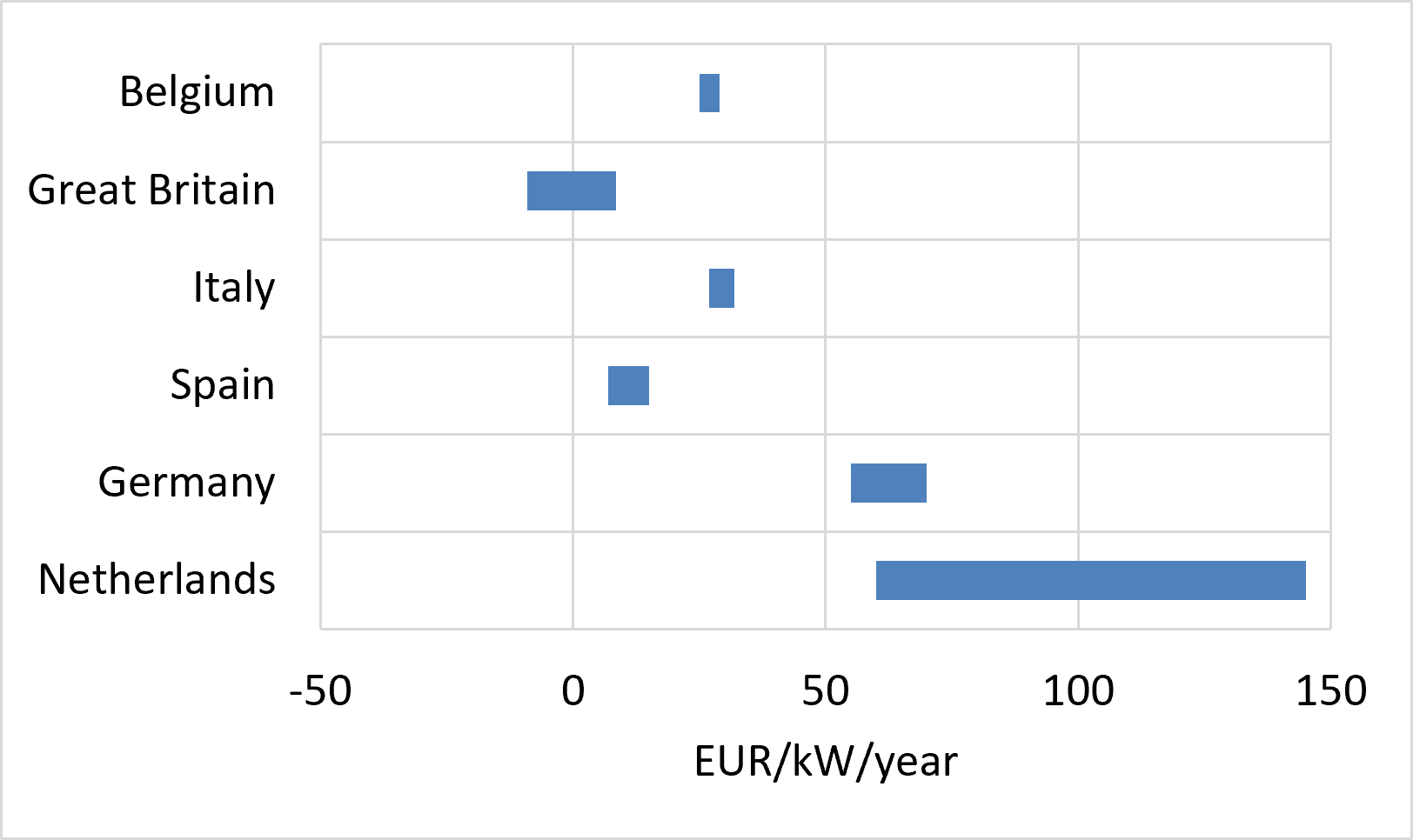
The Dutch regime has always been technology-neutral, and batteries pay accordingly. Market fundamentals have been very attractive; strong spreads; high volatility and good ancillary service value to be captured. However grid fees at transmission level have, over recent years, exceeded €100/kW/year. Even with the attractive fundamentals, compared against markets where storage pays nothing, this at face value writes off the business case.
The Dutch response has been contractual rather than exemption-based. Developers can accept a non-firm or time-duration-bound transport contract, trading roughly 15% curtailment risk for a reduction in grid fee exposure of around 60%. The Netherlands has arrived, by a different route, at where Germany is heading. Grid connection offers just across the border are almost guaranteed to come packaged with specific curtailment conditions to promote this grid friendly behaviour.
Italy and Spain: zero today, but conditionally
Italy is usually described as exempt. It is more accurate to say the exemption is procedural. Under ARERA Delibera 574/2014, electricity withdrawn purely to charge storage for subsequent injection can be treated exempt of charges. The relief is granted on application and supported by certified technical evidence. It is administrative rather than statutory, and it can be revisited without primary legislation.
Spain applies tolls and charges to consumption rather than to the provision of flexibility, leaving standalone and hybrid front-of-meter storage effectively unexposed.
In both markets the revenue side is moving toward contract. Italy’s MACSE mechanism awarded around 10 GWh of 15-year storage contracts in its first auction. In Spain, developers are taking advantage of colocation opportunities with solar and striking hybrid PPAs with utilities and industrial players. Revenue certainty can help navigate any incoming grid fee reform.
Commercial implications
Underwrite the structure, not the exemption. The capacity-versus-energy distinction moves returns by an order of magnitude more than the fee level does. A stress test that models grid fee risk as a single cost line, rather than as a choice of charging basis, is testing the wrong variable.
Price regulatory vintage as an asset attribute. In Germany and Belgium, FID date and connection agreement date now determine lifetime cost base. Two otherwise identical assets are no longer comparable on that basis alone, and acquisition diligence should treat vintage as a valuation input, not a footnote.
Treat locational and dynamic charging as an upside case, not just a cost to minimise. GB’s zonal TNUoS and Germany’s forthcoming dynamic fees can both pay a well-sited, well-dispatched battery rather than charge it. Siting and dispatch strategy should be built to capture that possibility, not simply to avoid the downside.
Don’t assume today’s zero-fee markets stay that way. Italy’s relief is procedural rather than statutory, and Spain’s exposure depends on flexibility remaining outside the scope of consumption-based tolls. Both rest on regulatory interpretation that can tighten without primary legislation.