“The gap between Germany’s coal exit and build of new gas isn’t a policy risk – it’s a price signal. Prices and spreads move on that mismatch long before new investment does.”
A phase-out that has, so far, run to plan
Germany’s coal phase-out is arguably one of the more orderly parts of its energy transition. The retirements have broadly followed the path set out in law, emissions have fallen, and renewables now supply the majority of the country’s power.
Coal phase out in Germany isn’t the challenge. The challenge is the lack of new build capacity coming in to replace it.
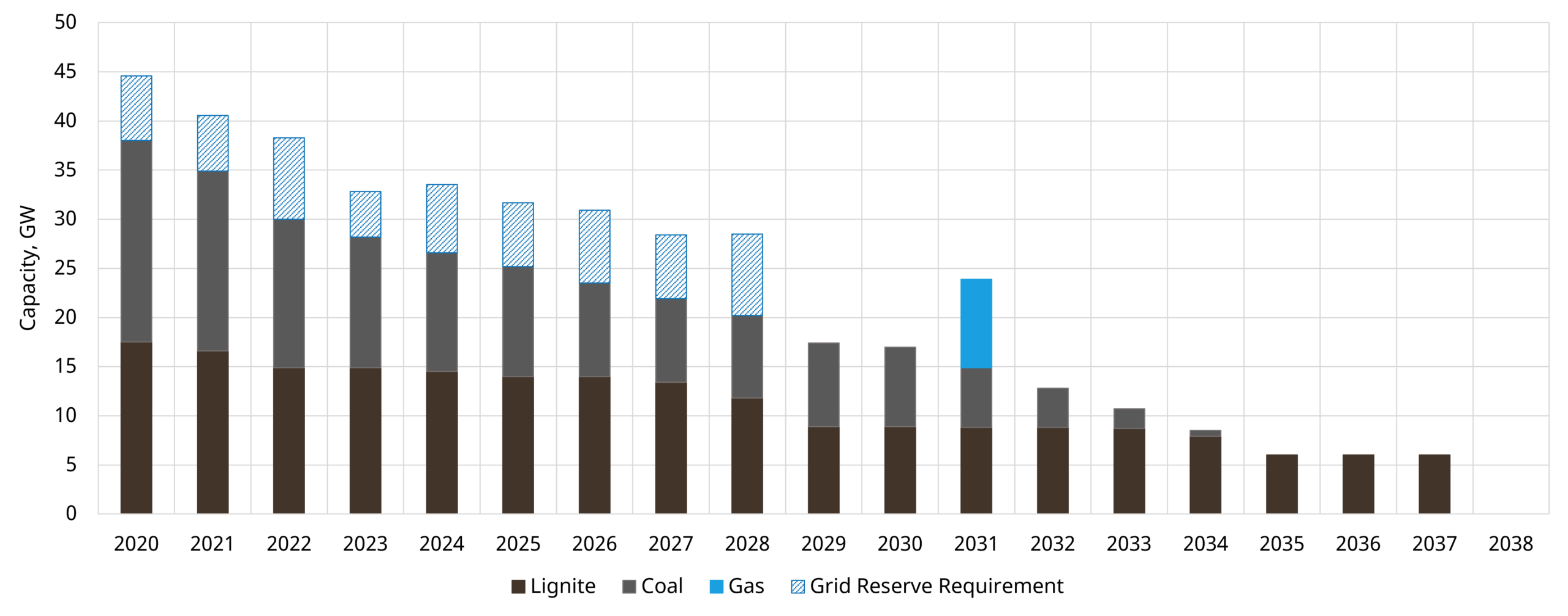
The Coal Phase-Out Act of 2020 (Kohleverstromungsbeendigungsgesetz, KVBG), mandated a complete exit from coal-fired generation by the end of 2038. Hard-coal closures to date have been compensated; but from 2027, they will be mandated by BNETZA. Lignite retirements run on separate operator-specific contracts rather than the auction system, and these aren’t uniform either: RWE’s Rhineland fleet was accelerated to close in 2030 in a 2022 deal, while LEAG’s eastern German plants remain on a later, unaccelerated timeline.
Operational capacity has fallen from~ 35 GW in 2020 to ~23 GW today. However, coal’s share of electricity generation has only fallen modestly from ~23% in 2020 to ~20% in 2025, while renewables have climbed from roughly 44% to over 57% over the same period. Chart 1 shows the coal closure timeline, alongside the new-build gas tender for 2031.
New build gas won’t fully replace coal
Germany proposes to replace coal with RES & gas for back-up. The government is planning two tenders later this year for up to a total of 9 GW of new controllable capacity, in practice largely gas, with commissioning targeted for November 2031.
Two constraints matter commercially. First, size: the tendered volume is significantly smaller than the firm coal and lignite capacity leaving the system over the same window. Second, timing: the auctions have slipped repeatedly, two rounds are now planned for the second half of 2026, and industry estimates put around five years between auction and operation – which is why the plants are not expected to run before the early 2030s at the earliest. Meanwhile, deteriorating economics for coal assets could continue to push plants out of the market faster than the statutory schedule requires. Faster exit, later replacement: that is the crux of the security-of-supply question.
Three scenarios: how tight does it get?
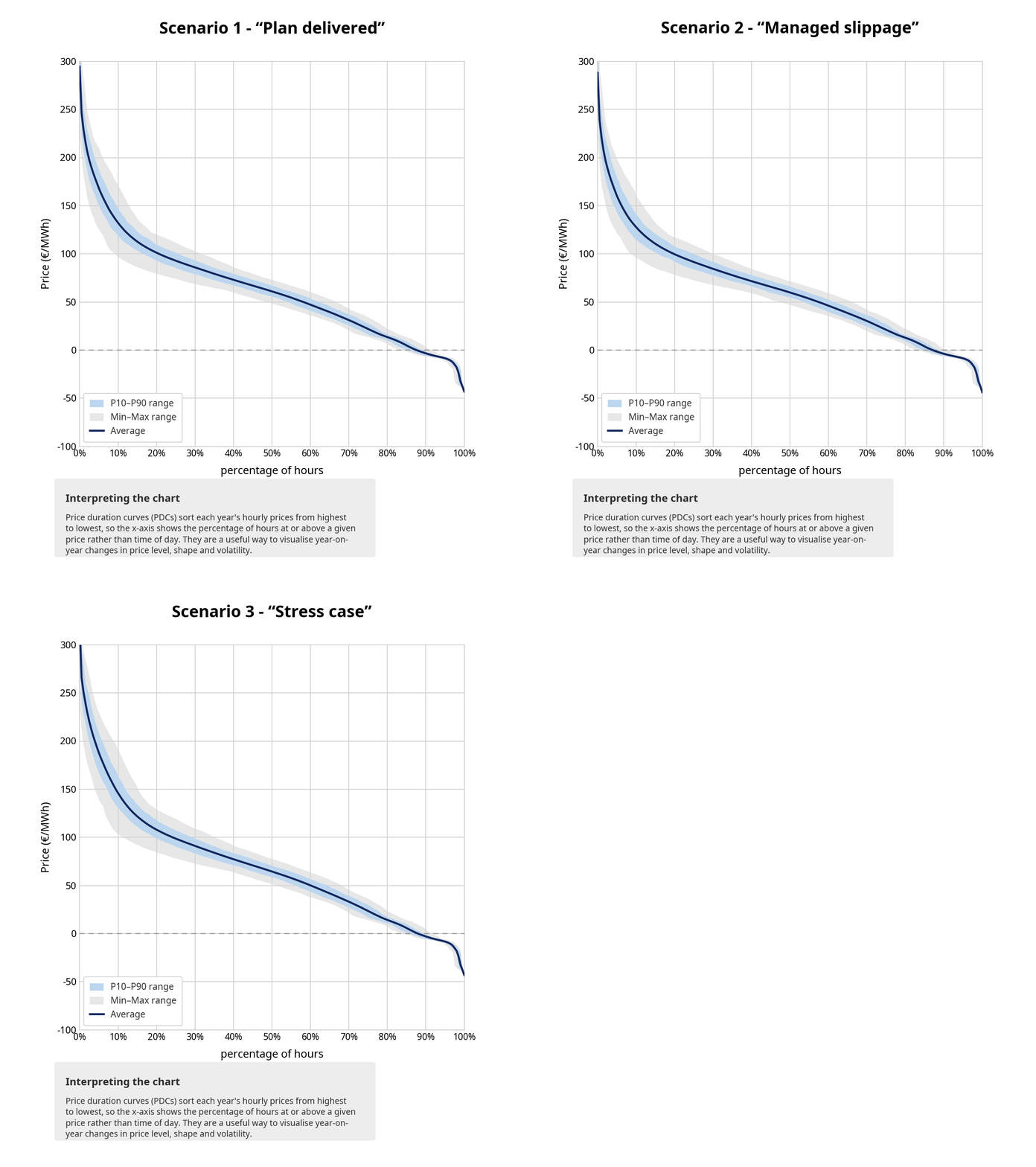
To size the impact, we have modelled how the interplay between the pace of coal retirement and the timing of gas commissioning could shape German power prices in 2032. Three scenarios frame the range:
- Scenario 1 – Plan delivered. The original coal-exit schedule holds and the gas tenders commission by November 2031 as targeted.
- Scenario 2 – Managed slippage. The coal phase-out is delayed, alongside some slippage in the gas tenders with 50% of the 9 GW delayed by one year.
- Scenario 3 – Stress case. Gas tender volumes are delayed by one year while coal retirement proceeds as originally planned – the tightest combination.
The chart shows that below around the 70th percentile of hours, the three curves sit almost on top of each other. Most of the year is still priced by the same low-cost renewables and thermal that dominate the stack regardless of scenario – that part of the picture doesn’t change. The story only starts once residual load starts to tighten significantly; by the top 10% of hours the average outturn of the stress case is already close to €20/MWh above the other two scenarios, and in the very tightest 1% of hours that gap widens to almost €30/MWh.
The managed-slippage case shows the same mechanism working in reverse. Delaying the coal exit alongside the gas delay keeps a unit in the stack for longer – so the same high-demand, low-wind hours that turn scarce in the stress case are instead still covered by cheaper coal generation.
The practical point is for flexible and dispatchable capacity specifically. Nearly all of its value is earned in that thin top slice of hours, resulting in not much move to the average price, but a significant move in flex asset value.
A decision point approaches
The government is due to publish a monitoring report on the coal exit trajectory by August 2026, which will be the first official evaluation of the phase-out’s impact on supply security, prices and emissions, after earlier reviews were shelved during the energy crisis. Originally conceived as a document that might justify accelerating the exit, it now looks more likely to test the case for holding, or easing, the pace.
For investors in German power, the direction that review sets is a key signal to watch. But the average price alone won’t tell you much about it . As the scenarios show, a modest shift in the mean can sit alongside a much larger shift in the shape of the distribution, and it’s that shape, not the average, that drives flex investment. The commercial question is no longer whether Germany exits coal, but how clearly the timing of the exit and its replacement line up.
Timera supports a range of investors navigating this ongoing market & policy risk. For a discussion of our relevant German bespoke project-level analysis or any broader themes within the German market, contact Sam Kayne, Principal, at sam.kayne@timera-energy.com.