


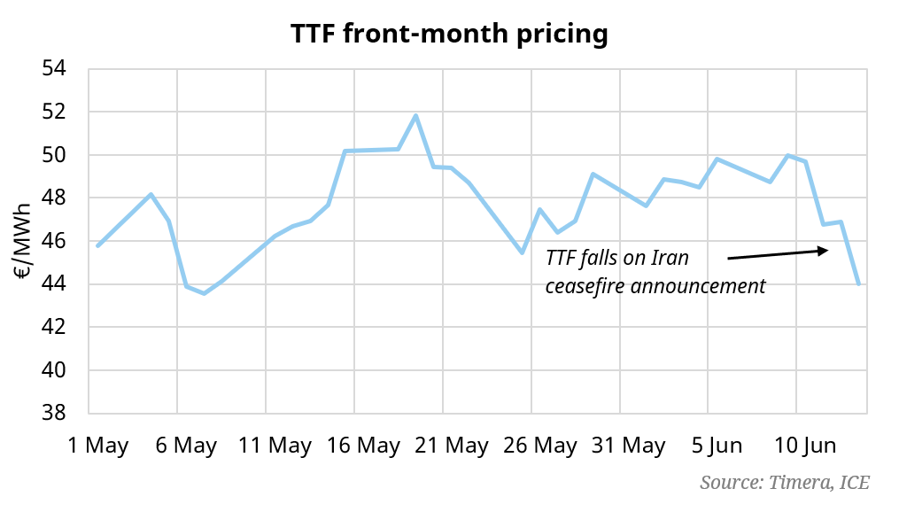
On Sunday 14th June, the US and Iran struck an agreement to end hostilities, slated to take effect on Friday with a formal signing in Switzerland. According to the US president, the US is lifting its naval blockade, and the Strait of Hormuz will reopen once the deal is signed, including a 60-day ceasefire window.
The US also claim that the Strait will stay “permanently toll-free”. For a market that has spent months pricing a closed chokepoint, this is the clearest de-escalation signal yet, with TTF front-month falling ~6.2% between Friday’s close and Monday’s open. With ~20% of global LNG trade (~8 bcm/month normally routed through the Straits, a durable reopening unwinds the single largest supply disruption weighing on both Asian and European gas markets.
This timeline aligns closely with the “De-escalation” scenario flagged in our analysis back in April. There are caveats however:
- Qatari supply won’t immediately recover. Liquefaction restarts are slow, with Ras Laffan having sustained lasting structural damage earlier in the conflict (12.8 mtpa capacity taken out for 3-5 years).
- Reopening the Strait is difficult; the US has flagged up to six months to clear suspected mines, and insurers will reprice war-risk cover gradually against a 800+ vessel backlog.
We will cover this topic further in our Q2 Global Gas Report, set to be released to Clients later this month. Reach out to Luke Cottell, Associate Director (luke.cottell@timera-energy.com) if you would like a sample extract.