

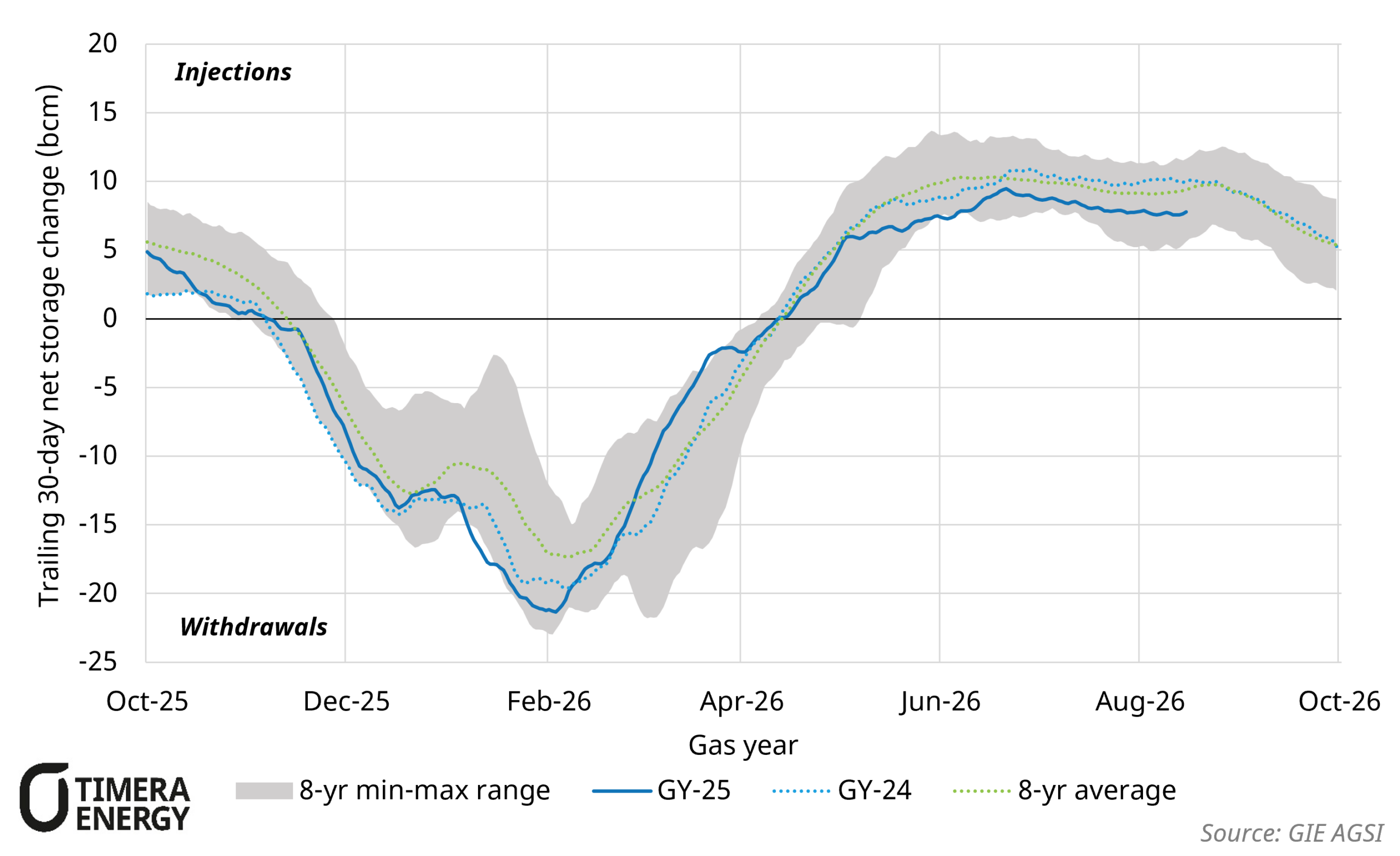
Gas year 2025 opened with European inventories at 85.2 bcm, some 7 bcm below the five-year average, and the gap widened from there. As the chart shows, trailing 30-day withdrawals ran consistently steeper than both gas year 2024 and the eight-year average through December to February, peaking above 21 bcm and pressing against the bottom of the eight-year range as a February cold spell was followed by the March closure of the Strait of Hormuz. Europe left winter with stocks ~28% full, at roughly 29 bcm its lowest end-of-March position since 2022 and over 6 bcm lower year on year.
Clearing a deficit of that size required injections running well above normal. The opposite has happened. Trailing 30-day injections have hugged the lower bound of the eight-year range since May, plateauing near 8 bcm against an eight-year average of 10-11 bcm and below last year’s pace. Stop-start transits through Hormuz, with laden LNG movements collapsing back toward zero through July, have left Europe competing with Asia for a limited sized pool of spot LNG, while a persistently backwardated TTF curve have kept injection economics intrinsically underwater. Policy has accommodated rather than forced the issue, with fill mandates relaxed rather than tightened and no intervention yet from policy makers.
Injections historically taper from September, so most of this season’s refill is already behind us. The one genuine offset is that USGC netbacks, having pointed towards Asia for much of the summer, have swung firmly towards Europe in recent weeks, with LNG deliveries into the region picking up accordingly, enough to support late-summer injections, but not to close a gap of this size. Our projections have Europe ending the injection season around 70% full, some 17.8 bcm below the five-year average and the lowest 1 October stock level in over a decade. That deficit translates directly into stronger winter LNG demand. In essence, Europe will need to outbid Asia for a significant share of US Gulf Coast cargoes, with the market balancing primarily through an Asian demand-side response. While new liquefaction capacity should offer some relief, where prices settle depends heavily on whether Qatari loadings normalise and on temperature outturns. With storage thin and prices thus facing having to run up a demand curve that steepens the further you climb, winter price risk is skewed firmly to the upside.
Timera Energy will be at Gastech 2026. If you’d like to discuss our outlook on European gas storage, or anything else on your radar, please contact luke.cottell@timera-energy.com to set up a meeting.