

EPEX SPOT launched its TBx Index suite in July. EEX followed with TBx Power Futures that went live on 21 September. This brought spread hedging onto a transparent, centrally cleared marketplace.
In today’s article we focus on TB2 and its implications for BESS owners and investors.
Overview of TB2
TB2 futures are available in Germany, France, GB and Italy (GB based on the two highest and lowest 60-minute periods). The futures are cash-settled against national day-ahead auctions: EPEX SPOT for Germany, France and GB, GME for Italy and OMIE for Spain. Negative and extreme prices are included.
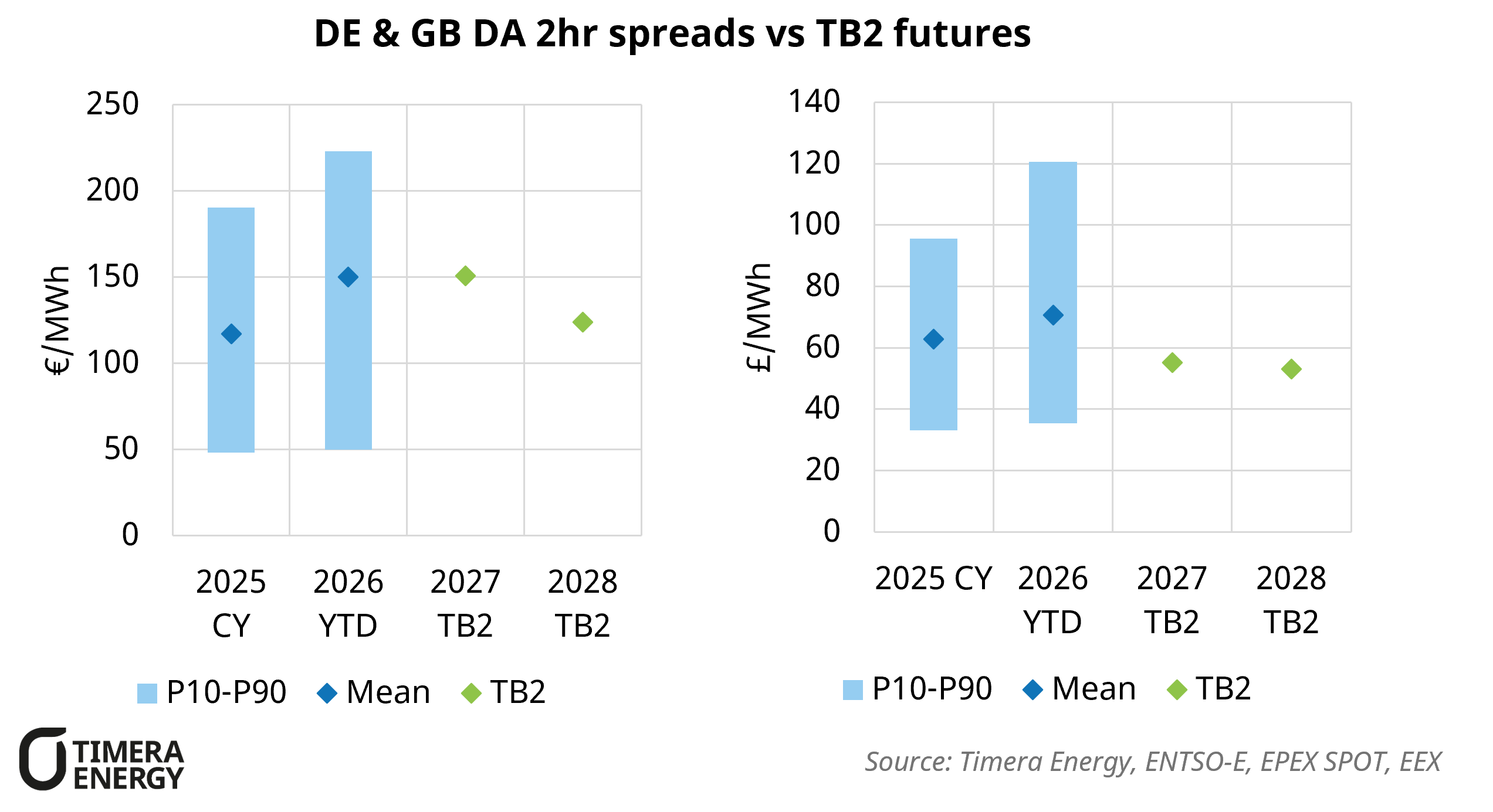
Chart 1 compares historical spreads with early TB2 prices. Currently, there is no open interest or traded volume. The prices from EEX in the chart represent the exchange’s daily valuation of the contract as of September 28, 2026.
Daily spreads are highly volatile
In Germany, the P10–P90 range for DA 2-hour spreads ran from roughly €50/MWh to €190/MWh in 2025. It has widened to around €50–220/MWh so far in 2026. GB shows a similar pattern, from roughly £30–95/MWh in 2025 to £35–120/MWh this year. A TB2 future works like a swap: one side pays a fixed price and the other pays the floating daily TB2 index. Cashflows from the contract therefore still vary day to day. For a battery owner that has sold TB2, those payments move in the opposite direction to its day-ahead arbitrage revenue, so the combined position locks in the fixed price, provided the asset captures the index spread.
EEX prices in gradual erosion for Germany
The 2027 TB2 contract sits at around €150/MWh. That is broadly in line with the 2026 year-to-date mean and well above the 2025 average of about €117/MWh. By 2028 it falls to around €124/MWh. With no traded volume or open interest, these prices reflect EEX’s calculation of implied spreads rather than a market view. Taken at face value, they imply spreads starting to compress later in the decade as the battery fleet grows, though part of the decline may also reflect lower expected gas prices.
GB is priced by EEX at a clear discount to recent history
The 2027 TB2 contract sits around £55/MWh and 2028 around £53/MWh. Both are below the 2025 mean of about £63/MWh and the 2026 year-to-date mean of about £71/MWh. That is consistent with further cannibalisation in Europe’s most mature battery market, although again this is EEX’s implied view rather than a traded price.
Implications for BESS investors
These curves set up different decisions for owners. In Germany, a 2027 hedge locks in something close to current realised spreads. In GB, hedging today means accepting a discount of around 20% to this year’s average in exchange for certainty. That is attractive only if you expect cannibalisation to be at least as severe as EEX’s implied prices suggest, or if revenue certainty is worth more to you than the potential upside.
The final consideration is deliverability. Selling TB2 fixes the value of a day-ahead position, but it opens up other risks.
- Delivery risk: whether the TB2 spread can be captured physically in the day-ahead auction.
- Availability risk: an outage leaves the owner paying the floating leg with no revenue to offset it.
- Strategy basis risk: most operators will not simply trade the day-ahead auction to deliver against the spread, but will optimise across intraday, balancing and ancillary markets, so realised revenue will diverge from the index.
Ultimately, TB2 is a useful risk management product, and TBx is positioning itself as the neutral reference that bilateral storage deals have lacked. But given delivery timelines that are short relative to typical debt tenors, and the risks above, it is unlikely to be widely considered a financing instrument. As liquidity builds, expect the forward curve to become a key input for hedging decisions and asset valuation rather than debt sizing.