“Italian investor now have the green light on the next large BESS tender”
Terna has recently announced the dates of the next MACSE auction targeting 2029. The tender will take place on the 24th November 2026. The participation of BESS assets will be subject to an admission process with key deadlines to meet.
With this announcement, Terna has also published the final discipline of MACSE, approved by the Italian Energy Ministry in March 2026. It has also confirmed the prudent assessment of the additional 32 GWh of storage requirement by 2030 to be financed by MACSE.
In this article we provide an overview of the latest developments regarding the next Italian MACSE and Capacity Market auctions.
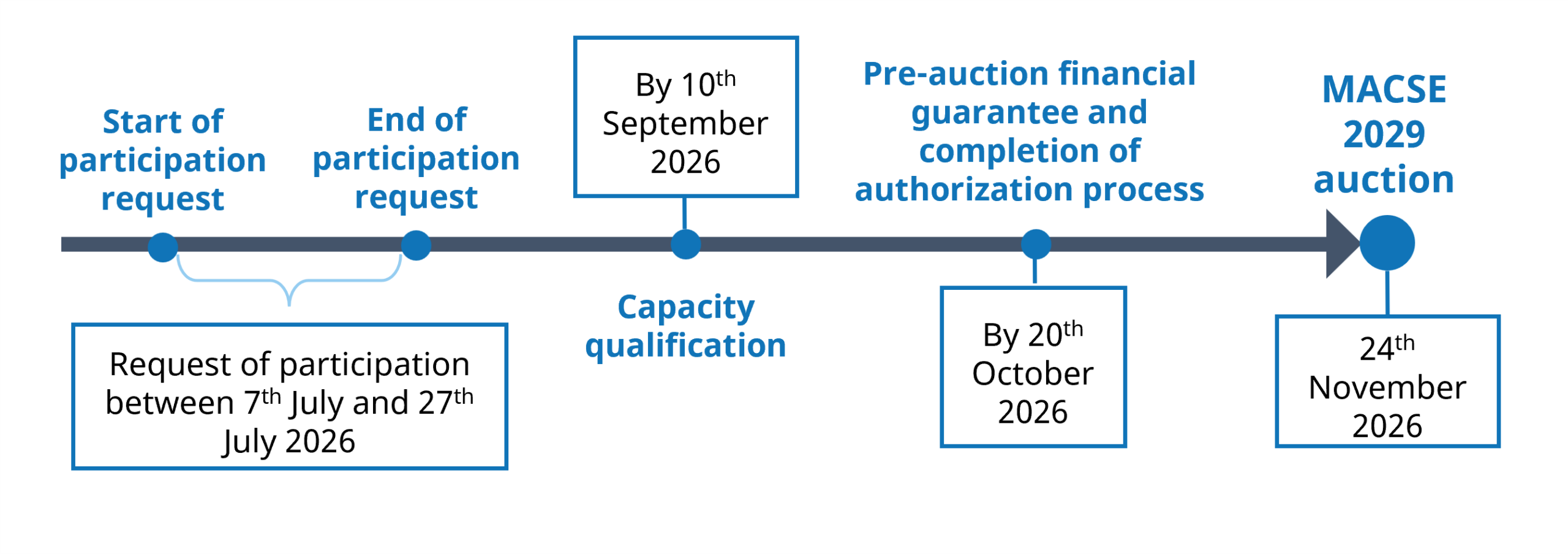
MACSE 2029: the timelines for the auction participation The next MACSE auction targeting 2029 will happen on the 24th November 2026, but there are preliminary steps to consider for participation. Diagram 1 shows the key timelines that will lead to the competitive tender.
Some important considerations:
- Registration for the tender must be completed between 7th and 27th July 2026.
- Storage asset technical details and their capacity qualification need to be submitted to Terna by 10th September 2026. Capacity qualification will differ from the previous auction; indeed, the coefficient of storage duration and round trip efficiency will directly affect the qualified capacity and the amount of capacity bid into the auction. This means that it is not possible to qualify the full physical capacity of BESS, unless the asset is qualified with neutral coefficients, i.e. as a 4-hour system with 85% RTE, where the coefficients are equal to 100% (the same technical parameters of the latest MACSE auction were confirmed for this new tender).
- Pre-auction financial guarantee details are required by 20th October 2026. The guarantee will be 10% of the qualified asset capacity (MWh) multiplied by the reserve auction premium (€/MWh), which will be defined by ARERA (last auction had a value of 37 €/kWh). Due to the new regulation on qualified capacity, the financial guarantee will be higher compared to last MACSE tender for storage durations above 4hr and for round trip efficiencies below 85%. This pre-auction guarantee will be again aimed at discouraging speculative auction participation.
MACSE 2029: the auction quota and zonal competition
As we discussed in a previous article, the next MACSE auction quota will be maximum 16 GWh, with potential reduction equal to capacity eventually awarded with a Capacity Market 2029 contract in the MACSE-eligible zones before the 4th November 2026. The final quota (which will be communicated 20 days before the auction) will act as a national upper bound of qualified capacity selected in the auction.
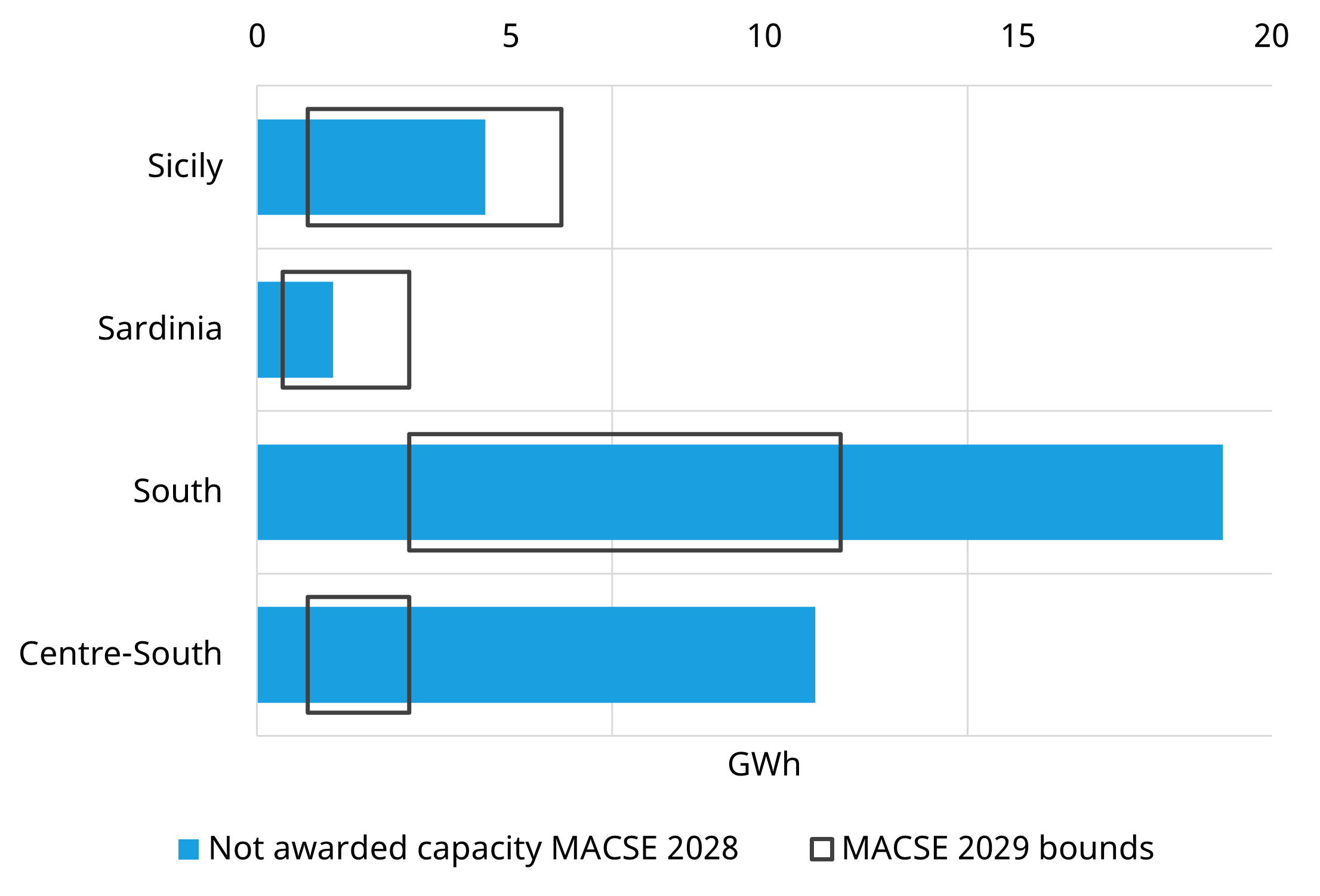
Chart 1 displays the zonal upper and lower bounds in the zones that will be addressed by the next MACSE auction, and it compares them with the capacity that participated in the latest MACSE auction but was not awarded. This amount alone is already more than double the 16 GWh national cap. This figure does not yet capture new projects authorised ahead of the auction registration deadline, so it potentially understates how intense the competition is set to be again.
Chart 1: Zonal MACSE quotas vs. non-awarded capacity from 2025 auction
Source: Timera Energy, Terna
Capacity Market as an alternative route?
The next CM auction targeting 2028 was originally expected by the end of summer 2026, yet the delays in the announcement are making this increasingly unlikely. As a result, the next CM auction will most likely be held after September 2026, closer to MACSE.
As we previously discussed, the final MACSE quota depends on the outcome of the CM auction in the South and Islands. This means that for projects in these zones, CM and MACSE represent a strategic fork.
MACSE offers a dedicated storage contract, but at the cost of high competition and binary auction risk. The CM can be stacked with a tolling agreement, offering a more flexible commercial structure with lower auction risk exposure.
That said, a CM participation in the South still presents a higher risk profile due to the competition from MACSE capacity and the complexities potentially introduced by the new CM regulation, whose consultation was launched last February. We discussed these topics in a previous article.
There is also the potential case of a CM 2028 auction happening after the next MACSE auction, and eventually even in early 2027. This scenario would further enhance expected participation in the MACSE 2029 auction, and it could create greater time pressure for awarded projects to comply with the project realisation timelines and CM discipline requirements given the 2028 COD target.
Nevertheless, CM participation may still be a viable option for Southern projects given that a new MACSE auction will most likely be held next year, with a 2030 COD target and a potential quota of up to 16 GWh. As for the next tender, this amount may be reduced by the capacity awarded in the CM before the auction and so the same strategic fork discussed above would still apply. Additionally, further delays to RES deployment in the South may lead to a new downward review of MACSE storage requirements, leading to a compressed future auction quota.
For Northern projects CM currently remains the only regulated mechanism available to sustain a successful route to market. Once finally launched, the FER-Z may represent an attractive new mechanism for both RES and storage, especially for collocated assets.
How Timera can help
We recently published our Q1 2026 quarterly update of the Italian BESS Subscription Service, covering revenue stacking projections for all Italian bidding zones and grid nodes across all contract configurations – Merchant, MACSE and CM – together with market scenario analysis and baseload and RES-captured price projections. It is designed to underpin bankable investment cases for BESS and renewable projects across Italy.
For more information, contact Alessio Cunico (Associate Director) alessio.cunico@timera-energy.com or Steven Coppack (Power Director) steven.coppack@timera-energy.com.