Terna’s second MACSE auction, held on 24 November, awarded 16 GWh of storage for delivery from 2029, 60% more than the 10 GWh awarded for 2028. Competition was intense: 67 GWh qualified, 43 GWh was bid and only 16 GWh won. The weighted average premium fell to €11.4k/MWh/year, 12% below the €13.0k of the first auction.
The result confirms MACSE as a low-cost route to long-duration flexibility. It also concentrates ownership further and raises the bar on capex efficiency. We review the results, ownership and returns, and what comes next for investors.
Chart 1: MACSE 2029 auction – awarded capacity by player and zone vs Terna need, with premiums
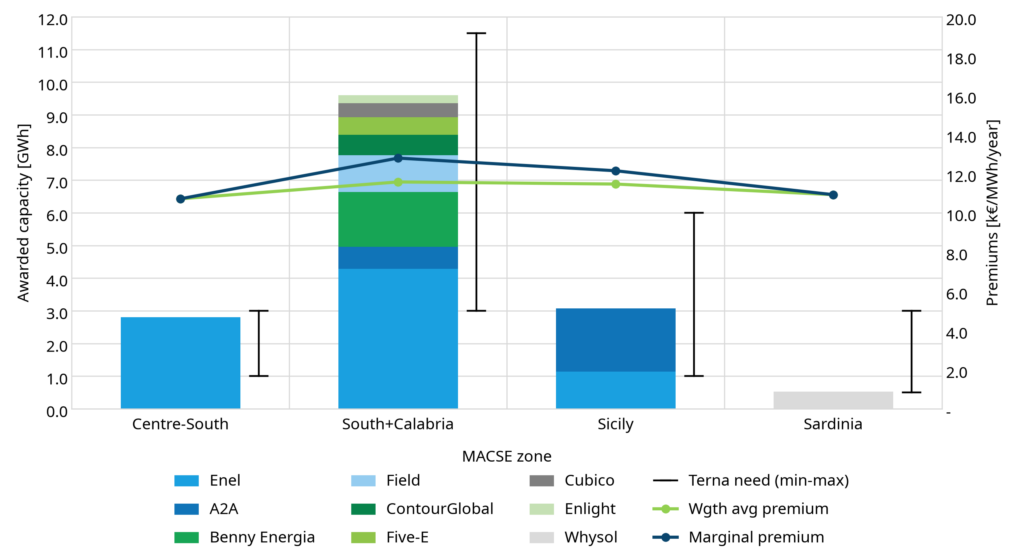
Source: Timera, Terna (MACSE auction results 2025 and 2026), MASE/Terna; provisional results of 24 November 2026. Centre-South and Sardinia each have a single winning unit, so the marginal and average premiums coincide.
More volume, lower and flatter prices
Chart 1 (2029) and Chart 2 (2028) compare the two auctions by zone. In 2028 marginal premiums ranged from €14.4k (South & Calabria) to €18.8k/MWh/year (Sicily), with the islands priced up by their minimum volume requirements. In 2029 the range narrowed to €10–12.8k and the islands cleared close to the mainland.
South & Calabria again took most of the volume: 9.6 GWh, within Terna’s 3–11.5 GWh need, at an average of €11.6k. Centre-South (2.8 GWh) and Sardinia (0.5 GWh) were each won by a single unit, so the marginal premium is the bid price: €10.7k for Enel at Montalto di Castro and €10.9k for Whysol at Selargius, which won a second contract for the same project after it was only partly awarded, as the marginal unit, in 2028.
Chart 2: MACSE 2028 auction – awarded capacity by player and zone vs Terna need, with premiums
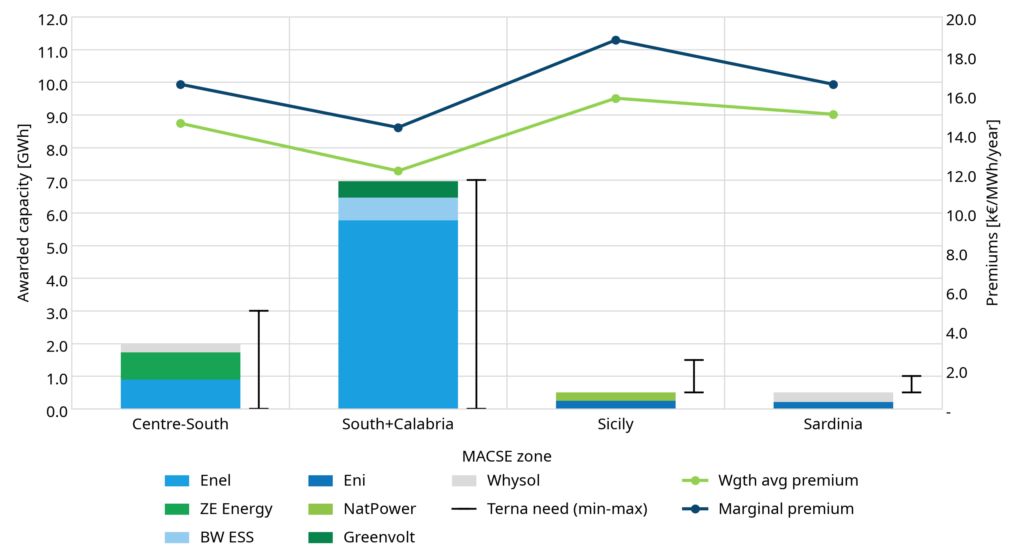
Source: Timera, Terna (MACSE auction results 2025 and 2026), MASE/Terna. Terna need = minimum-maximum zonal need for the auction. Premiums in real terms as awarded (pay-as-bid).
Why only 43 GWh of 67 GWh qualified was bid
Two factors explain the gap between qualified and bid volumes:
- Withdrawals. Recent permitting of large brownfield Enel and A2A projects in existing power plants sites changed the competitive landscape, and some qualified participants chose not to bid. The auction was already expected to be very competitive, and market operators were already considering alternative and less risky routes to market.
- Partial bidding. Some players bid only part of their qualified capacity to keep a merchant tranche exposure. Enlight’s two 100 MW Nardò projects, for example, secured 120 MWh each, leaving more than 80% of their power capacity merchant. As we have previously advised, in such a competitive market a merchant tranche, stacked on MACSE with a well-negotiated toll or floor contract, lets asset owners capture flexibility upside while keeping the project bankable.
Physical capacity: Enel above 50%
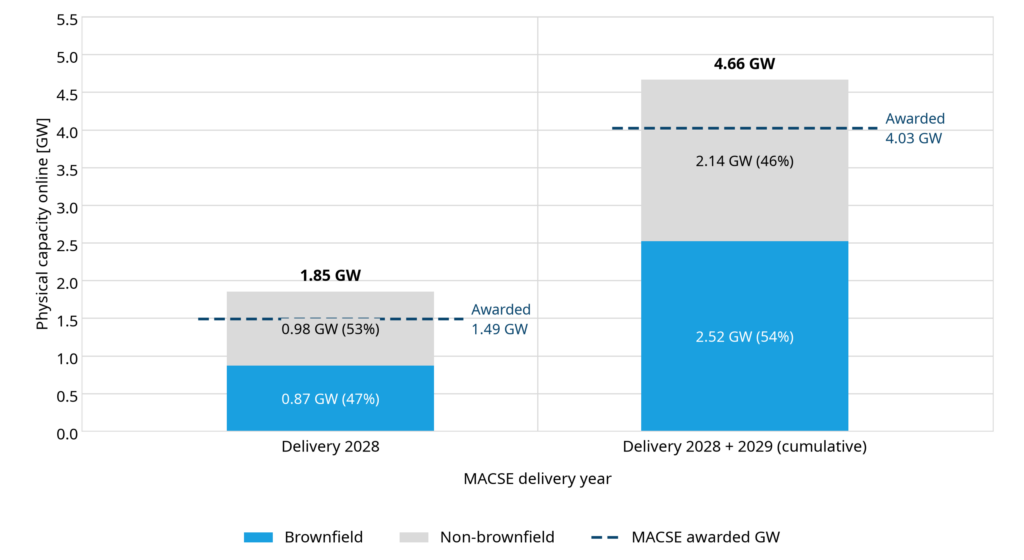
Awarded capacity understates what will be built, because winners retain merchant tranches for degradation management, commercial strategy or if clearing at the margin, as discussed in our previous article. On permitted plant sizes, MACSE winners will bring 1.9 GW online for 2028 and 4.7 GW cumulatively by 2029, against 1.5 GW and 4.0 GW of awarded power
Enel will own 54% of this capacity (2.5 GW), rising to 57% in South & Calabria. Around 1.3 GW of it sits at Brindisi, a critical node of the southern grid (Diagram 1).
This matters beyond MACSE. The balancing service provider keeps MSD trading control of MACSE capacity, even though 80% of the margins are passed to Terna. One player controlling most of the fast flexible capacity in a constrained zone raises market power risk in ancillaries and balancing, both in congestion management around Brindisi and in price formation across the South. For other investors this impacts the MSD upside in southern merchant cases while for the regulator it is a clear monitoring point.
Chart 3: Physical capacity online from MACSE winners by operator
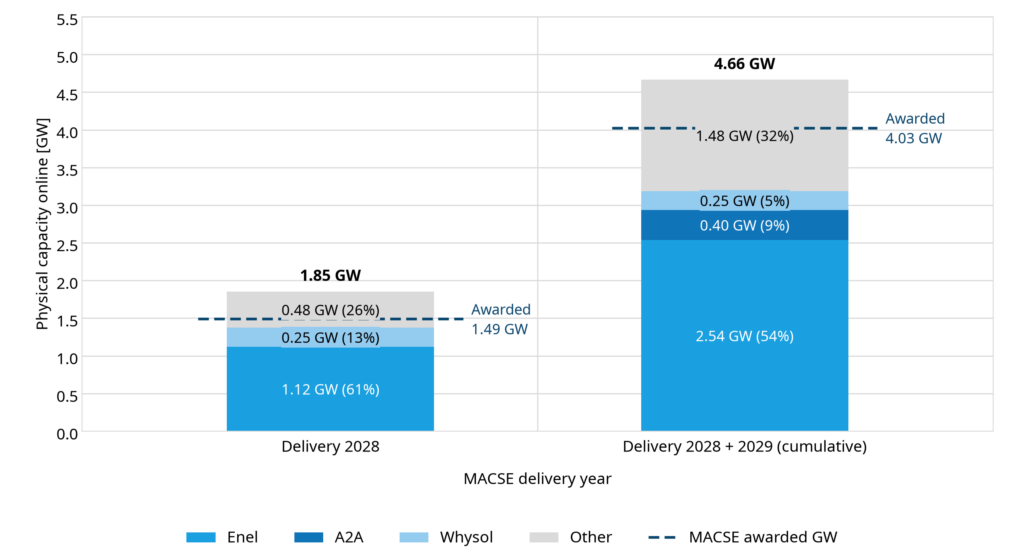
Source: Timera Italian BESS project database, Terna. Physical capacity = permitted plant size of each winning unit, including merchant tranches, higher than the awarded capacity.
Diagram 1: Position of physical capacity backed by MACSE 2028-2029 contracts
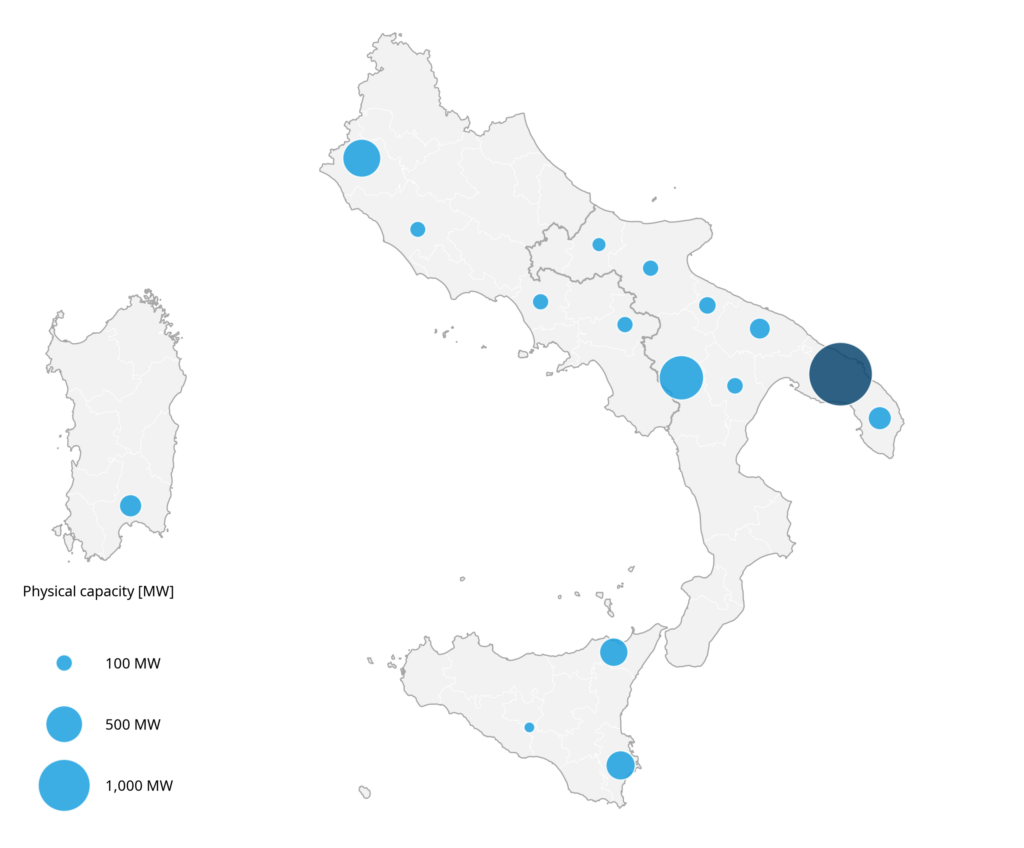
Source: Timera Italian BESS project database, Terna. Brindisi is represented in dark blue. Province geographical approximation. Not all BESS capacity in Brindisi is of Enel, but more than 85% of the MW in that province will be optimized by the Italian incumbent.
Brownfield sites and the capex imperative
Chart 4 splits the same capacity by site type. All brownfield capacity, 2.5 GW or 54% of the total, belongs to Enel and A2A, on existing power plant sites such as Brindisi, Montalto di Castro, Civitavecchia, Priolo and San Filippo del Mela (Timera assumption based on expected “Procedura Autorizzativa Semplificata” PAS documents not yet released). Reusing owned land and existing grid connections cuts capex, connection risk and lead times, an advantage reflected in their bids as discussed in last year article.
For MACSE investors capex is the main lever. Chart 5 shows the capex required for a South-zone 6.5-hour project earning the 2029 average premium: €0.61m/MW for an 8% IRR, €0.75m/MW for 6% and €0.97m/MW for 4% (€93–149/kWh). At €1.0m/MW the IRR falls to 3.7%.
Chart 4: Physical capacity online from MACSE winners by operator and site type
Source: Timera Italian BESS project database, Terna, MASE
Chart 5: Capex required for a target project IRR – South zone, 6.5-hour MACSE project
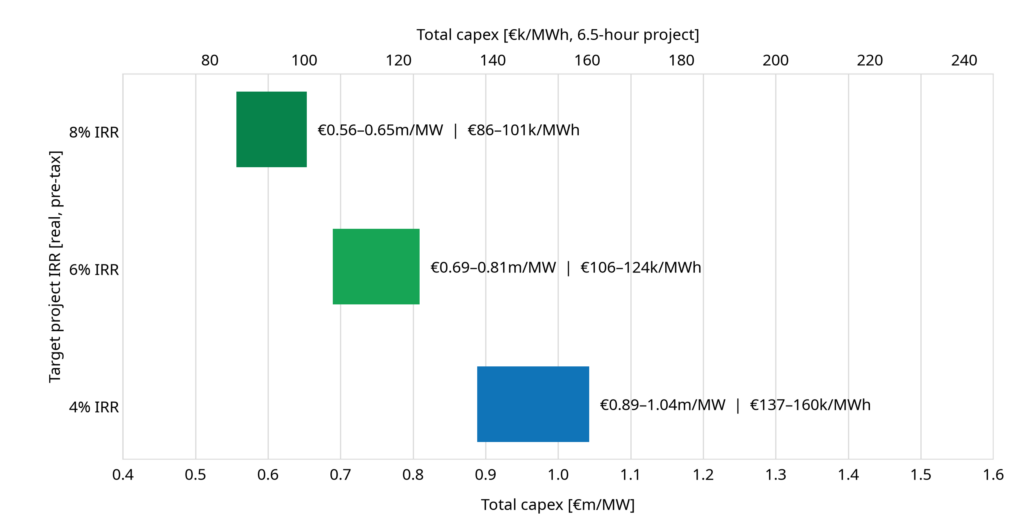
Source: Timera IT BESS Valuation (Q3-26, Timera Central scenario). Assumptions: South zone, MBR node PSR_316, transmission-connected, COD January 2029; MACSE premium of €11.4k/MWh/year (2029 average) for 15 years on 90% of power and 90% of energy capacity, merchant tail after 15 years, overnight capex Real 2026 terms, pre-tax, unlevered.
Next steps: CM and offtake contracts ahead of MACSE 2030
Our database shows more than 20 GW of permitted BESS still uncontracted, including around 7 GW in the North and Centre-North. The next opportunity is the Capacity Market auction for 2028 delivery on 21 December.
Coupled with a floor or toll, a CM contract can still make projects bankable, despite recent cuts to BESS derating factors. Floors and tolls at around €60k/MW/year have been signed for southern projects over the past year, above the ~€46k/MW/year a 4-hour asset would earn at the 2029 MACSE average premium. The MACSE result may, however, reset expectations in the next round of BESS offtake negotiations.
However, capex will still prove to be the key strategic factor for project in South and Island due to very low derating factors (21% for 4hr BESS), while more CM premium margin is allowed in North and Centre-South (40% and 51% respectively). Next CM auction is expected again to be very competitive, especially due to consideration of MACSE capacity under more generous CM 2027 derating factors.
Timing still matters. Volumes in the 2030 MACSE auction (expected again at maximum 16 GWh) will be reduced by the capacity awarded in the CM, so projects that secure a bankable business case and begin construction before next MACSE auction gain a natural advantage.
Timera supports clients on Italian power and gas investment, pricing, asset valuation and hedging. We have supported clients in MACSE and CM auctions and in major M&A processes across Europe with our bankable market outlooks. To discuss how we can help, contact alessio.cunico@timera-energy.com (Director of Analytics).