

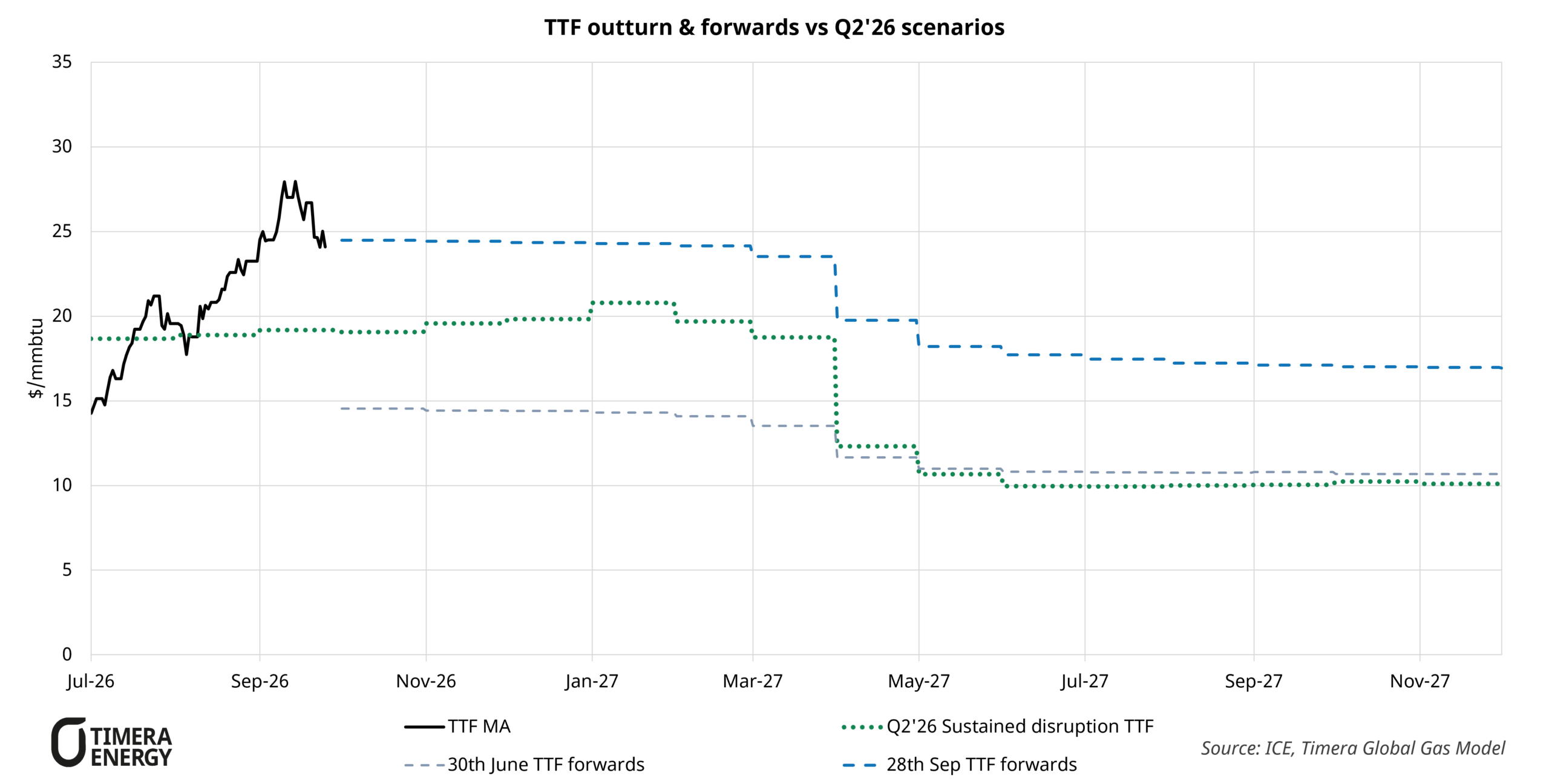
In Q2, we set out two short-term scenarios for how global gas prices could respond to the Hormuz crisis (see our blog here for further context.) Our de-escalation scenario saw flows normalizing through September, with TTF holding around $13-14/mmbtu into late 2026. Our sustained disruption (SD) case assumed Middle Eastern cargoes would return gradually through Q4’26, keeping prices at $19-21/mmbtu over the winter. At end-June the forward curve sat alongside de-escalation, pricing a return to ‘normality’ by winter.
Since then, prices have tracked, and subsequently overshot our SD path. With the Strait still closed, TTF has risen through gas to coal & gas to oil switching levels. With winter approaching, the market stopped being able to rely European storage flex and instead prices have been driven up further as Europe competed more aggressively with Asia for flexible LNG cargoes. By late September, TTF sat $5-8/mmbtu above SD.
We called the direction, but our SD scenario was too optimistic in two ways. It assumed disruption would ease from early winter, which now looks unlikely. And it assumed Asian demand would be more price elastic between $15-20/mmbtu, with it in practice holding up better than expected, in part due to elevated diesel prices and cross commodity nature of this crisis.
Forwards have moved from pricing a short shock in late June to pricing prolonged disruption risk well into 2027: Winter 26 is up ~ $10/mmbtu and summer 27 sits ~$7/mmbtu higher, well above where both of our Q2 cases normalized.
Our newly published Q3’26 short term outlook sets out under what conditions that summer 2027 pricing is justified. For sample analysis, contact Kaan Cengiz (Senior Analyst) at kaan.cengiz@timera-energy.com